5 Best AI Music Video Generators for Songwriters in 2026 — Here’s the Winner
Why I Ran This Test
I’ve been writing lyrics for a long time. And when AI music video generators first started appearing, I was skeptical. Most of them felt built for DJs and producers — people who care more about the beat than the words.
The phrase poetry in motion keeps coming back to me. Song lyrics are saturated with idioms — when I write “I’m drowning in your memory,” I’m not picturing a swimming pool. I’m asking you to feel the suffocating pull of absence. The question I wanted to answer in 2026 was simple: which AI tool actually understands that?
I tested five platforms — Luma Dream Machine, Kaiber, Neural Frames, Runway Gen-3, and Freebeat — specifically through the lens of a lyricist and storyteller. I used the same idiom-heavy tracks across all five. Here’s what happened.
Quick Comparison: All 5 Tools at a Glance
| Tool | Audio-Reactive | Narrative Control | Lip-Sync | Lyricist-Friendly | My Rating |
| Luma Dream Machine | None | None | ✗ | ✗ | 5/10 |
| Kaiber | Energy only | Limited | Partial | ✗ | 6/10 |
| Neural Frames | Frequency-level | None | ✗ | ✗ | 7/10 |
| Runway Gen-3 | None | Manual only | Partial | ✗ | 6.5/10 |
| Freebeat | Full song structure | End-to-end | 90%+ | ✓ | 9.5/10 |
1. Freebeat — The One That Actually Read the Lyrics (Winner)
Best for: songwriters, storytellers, and artists who want their words to actually be seen
This is where my testing got genuinely exciting.
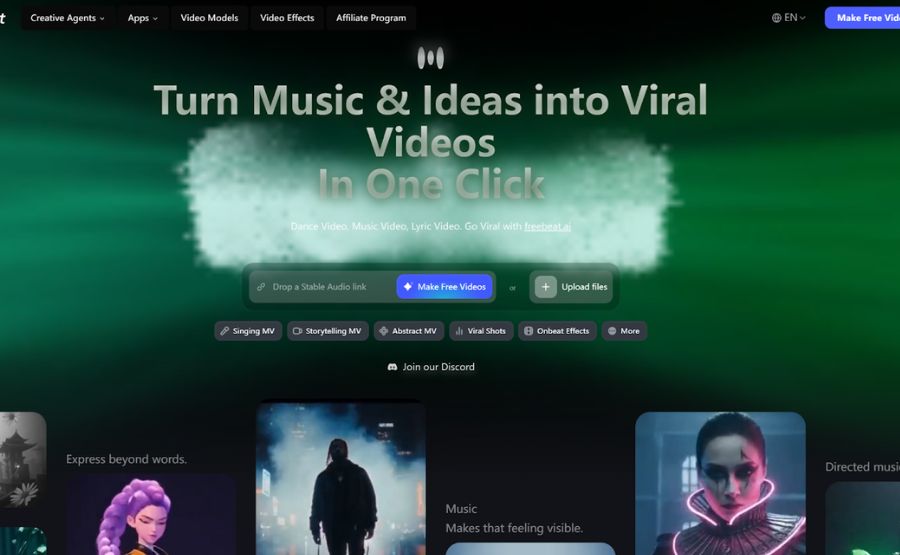
Freebeat is the first tool I tested that behaves like it has actually read the lyrics — not just scanned them for keywords, but understood them the way a thoughtful collaborator would. It combines audio-reactive visuals, narrative control, and character consistency in a way that treats a song as a piece of storytelling rather than a sequence of beats.
Storytelling Mode: Idioms become images
Freebeat’s Storytelling Mode was the feature that most directly addressed what I care about as a lyricist. Instead of responding only to frequency data, it maps a visual narrative to the full song structure — intro, verse, chorus, bridge, outro — mirroring the emotional arc of the words.
When I fed it a track where the bridge said “I’m standing at the crossroads,” the visuals delivered that: a character, a threshold, a moment of choice rendered cinematically. That’s not a coincidence. That’s structural audio-reactivity working as it should. The difference between this and every other tool in this test was stark — the others gave me atmosphere at best, Freebeat gave me meaning.
The lip-sync test
I was specifically watching for this. Lip-sync failures are immediately obvious to any listener, and for songwriters it’s personal — these are your words in someone’s mouth.
Freebeat achieves over 90% lip-sync accuracy by deriving mouth movements from vocal phoneme analysis rather than generic animation templates. In practice, the character mouths your specific phrasing with emotionally coherent timing. I tested it on a verse with several consecutive idioms and the result felt like a performance, not a simulation. After sitting through four tools that couldn’t do this at all, the gap was obvious.
Stage Performance Mode
Not every lyric needs a narrative arc. Some songs are just a singer and their words, performing. Freebeat’s Stage Performance Mode handles this with concert-style close-ups, wide shots, and dynamic camera angles — all while maintaining stable character identity across cuts. This solved the morphing problem that ruined Kaiber’s results for me.
The complete workflow
Because I’d been using Suno to produce tracks from my lyrics, the integration here completed the pipeline. I pasted a Suno link directly into Freebeat — no downloading, no file conversion. Freebeat extracted the audio, analyzed its structure, and generated a synchronized cinematic video that respected the pacing of every word. Written lyric to produced song to finished music video, without touching a single editing tool.
For independent songwriters and creative writers curious about what the technology can do before committing, Freebeat offers a free AI music video generator entry point — making it accessible to poets and songwriters at every stage of their career, not just those with production budgets.
Key features I used:
- Storytelling Mode: Visual narrative mapped to full song structure (verse, chorus, bridge, outro)
- 90%+ lip-sync accuracy — phoneme-driven, not template-based
- Up to 2 consistent characters maintained across the full video
- Stage Performance Mode for concert-style performance content
- Shot-by-shot editing — regenerate specific segments without restarting
- Direct Suno link integration — no file management required
My verdict: The most complete solution I found for songwriters and storytellers. Freebeat is the best AI music video generator for anyone whose work lives at the intersection of language and image.
2. Luma Dream Machine — Fast Clips, Deaf to the Lyrics
Best for: Quick visual teasers and standalone social content
I’ll start here because Luma was the tool I was most curious about going in. The visual quality is genuinely impressive — fast generation, high fidelity, beautiful motion. I fed it a prompt inspired by one of my tracks and the output looked cinematic.
Then I added the actual audio.
Where it stopped
Luma ignores audio entirely. There is no audio input, no beat detection, no awareness of song structure. What I got was a beautiful clip that had absolutely no relationship to the words I’d written. The chorus hit, and nothing changed. The emotional peak of the track landed over footage that was going through its own unrelated motion.
For a lyricist, this is a fundamental problem. The visuals didn’t read between the lines — they didn’t read anything at all.
My verdict: Visually impressive, musically oblivious. Useful for standalone social promos, not for bringing idioms or narrative lyrics to life.
3. Kaiber — Stylized Loops That Miss the Story
Best for: Anime-style aesthetics and quick Spotify Canvas loops
Kaiber has a loyal following and I can see why. The 2D stylized visuals are distinctive, and if your track has an anime or illustrative identity, it can produce something genuinely cohesive. I ran a melancholy ballad through it and the visual mood was roughly right — dark palette, slow motion.
But the moment I needed something specific to happen, Kaiber lost me.
Where it stopped
The tool reacts to audio energy but doesn’t understand song structure. It can’t tell a verse from a chorus, a build from a drop. I had a bridge where the lyric pivots — “and then the silence said more than the words ever could” — and the visuals just kept doing what they were doing, indifferent to the turn.
Characters also morph unpredictably between frames. When I needed a recognizable figure to carry an emotional arc across two minutes of video, I got a shape-shifting figure that undermined the storytelling entirely.
My verdict: Great for stylized short loops. Struggles with narrative continuity and idiom-specific emotional moments. Not built for songwriters who need the visuals to follow the story.
4. Neural Frames — The Fever Dream That Forgot the Story
Best for: Psychedelic, ambient, and electronic music with abstract aesthetics
If Luma is deaf and Kaiber is vague, Neural Frames is at least listening — to the music, at least. It goes deeper than beat detection, isolating individual audio stems and assigning distinct visual triggers to each. The kick drum pulses. The synth swell shifts the color wash. For certain types of music, this is genuinely spellbinding.
I ran a couple of surrealist pieces through it and the results felt appropriately unmoored from literal meaning, which was right for those tracks.
Where it stopped
The moment I tried anything narrative, the ceiling appeared fast. Neural Frames cannot hold a character stable across shots. It cannot distinguish a verse from a chorus or a setup from a payoff. When I needed a character to stand at a crossroads — a real idiomatic moment of decision — what I got was abstract morphing shapes. Beautiful, but empty of the specific emotion I’d written.
For songwriters writing story-driven songs, that’s a fundamental mismatch. Neural Frames excels at atmosphere. It does not yet tell stories.
My verdict: Stunning for abstract and electronic aesthetics. Falls short the moment your lyrics carry specific characters, emotional arcs, or idiom-driven narrative moments.
5. Runway Gen-3 — Cinematic Quality, Manual Everything
Best for: Directors with editing skills who want maximum shot control
Runway Gen-3 produces the most visually realistic footage of any tool I tested. The lighting, the texture, the camera movement — it genuinely looks like cinematography. I generated a few scenes from prompts drawn from my lyrics and was impressed by the raw quality.
Then I tried to turn those scenes into a music video.
Where it stopped
Runway generates individual clips, typically five to ten seconds each. To build a complete music video I had to generate dozens of them, export each one, import them into an editor, cut them manually to the beat, and grade for consistency. There is no audio-reactivity, no structural awareness, no automated sync.
For someone like me — a lyricist, not a video editor — this workflow introduced exactly the production burden that AI tools are supposed to eliminate. The output was beautiful. The process was exhausting. And none of it had any inherent relationship to what the words were actually saying.
My verdict: Exceptional cinematic quality, but it’s a clip generator, not a music video generator. For songwriters without editing skills or time, the ROI is low.
Final Thoughts: Which Tool Is Actually for songwriters?
After running all five tools through the same idiom-heavy tracks, the hierarchy is clear.
Luma looks beautiful and hears nothing. Kaiber reacts to energy but loses the story. Neural Frames listens to the music but can’t hold a character or a narrative. Runway produces stunning footage that requires a video editor to turn into something that relates to your lyrics.
Freebeat gives your words a story.
If you write music where the lyrics are the point — where “I’m building bridges from the ashes” needs a character and a visual arc, not a generic explosion — then only one tool in this test was built for you. AI isn’t replacing the written word in 2026. It’s finally starting to honor it. And after testing all five of these platforms, Freebeat is the clearest evidence of that I found.


Post Comment