Absolute vs. Rotary Encoders: Choosing the Best Option for Your System
In industrial machinery, encoders play a critical role. They are necessary for tracking production lines. It is always better to know which encoder best suits your needs than to waste money later. In designing a system that requires smooth rotation, one of the most significant decisions you will make is how to measure the movement.
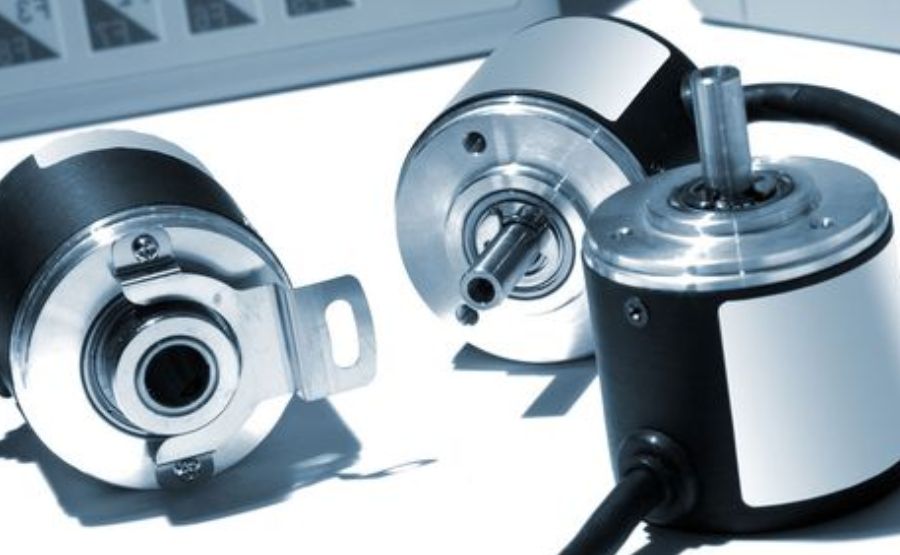
Encoders are devices that transmit the position or motion of a shaft or axle to indicators that machines can interpret. The most significant components in many automation and motion-control systems are two types of encoders.
Those two types of encoders are absolute encoders and incremental (rotary) encoders. Being aware of the differences between them will allow you to select the most appropriate one for your case.
What Is a Rotary Encoder?
A rotary encoder is a sensor that provides information about the rotation of a shaft. It transforms angular motion into output signals that can be considered to represent motional data. There are two major types: absolute and incremental encoders.
Both types have the same overall task: telling a system what a shaft is and how it moves. But they perform in very different ways, with different strengths and trade-offs.
- Incremental Encoders
Incremental rotary encoders produce electrical pulses with every shaft rotation. The number of pulses is recorded to determine the shaft’s distance and rotation direction. The signals are usually delivered through two out-of-phase circuits, also referred to as A and B, which help the system determine the rotation direction.
Incremental encoders are preferred where all one requires is relative motion information, such as measuring speed or detecting position changes. They cost less and are easier to integrate than absolute encoders.
The trade-off is that when the system loses power, the incremental encoders lose track of their position. In return, a system needs to begin with an established reference and re-home whilst starting.
What Is an Absolute Encoder?
An absolute encoder provides a unique digital value for each shaft position so that it remains aware of its position even after power loss. This can be done because absolute encoders provide a code for each shaft position. It also shows the designs, positions, number of rotations, and number of full revolutions.
Absolute types tend to be more complicated and costly than incremental methods. However, they excel at lowering allowable position levels of accuracy and reliability in environments where the system cannot afford to miss position information during power outages.
They are popular in robotics, CNC machines, elevators, automated warehouses, and other systems involving motion control, where position errors are far more severe than in other systems.
Main Differences and Applications
The decision between absolute and rotary incremental encoders is reduced to what is required by your system:
- Position Tracking and Loss of Power
Absolute encoders give direct positional information as soon as they are switched on. The position information remains even during a shutdown or interruption.
Incremental encoders must rehome (on power loss), which can cause delays or a complex process when precise positioning is needed.
- Cost and Complexity Factor
Incremental encoders tend to be less expensive and easier to implement. Absolute encoders are more costly and intricate.
They are more reliable and provide position feedback, which may be worth the cost in critical systems.
- System Performance
Incremental encoders are suitable for relative position and speed measurements. Absolute encoders are more suitable when precise real-time position information is required, but no initialization program is needed.
When choosing such a component for complex machinery, it only makes sense to trust Encoder Products Company. They are industry-leading with an exposure to worldwide export of their goods, based in Idaho, USA.
Conclusion
Absolute and rotary (incremental) encoders play a significant role in both motion control and automation systems. This is because the demands of your machinery will determine your decision, the repercussions of losing positional data, and the need to home in on startup.
By knowing these distinctions and setting them aside, you will have one of the most efficient systems that will run smoothly in the years to come.




Post Comment