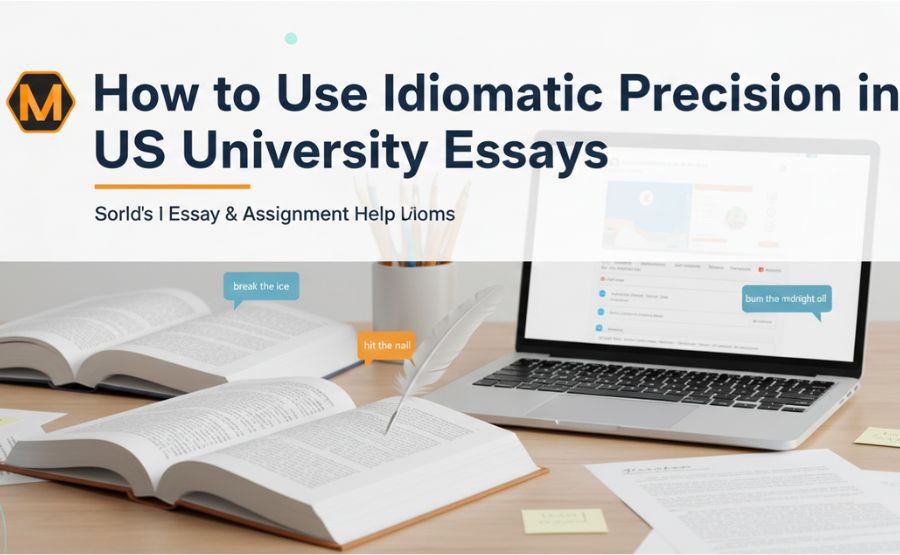
How to Use Idiomatic Precision in US University Essays
In the competitive landscape of US higher education in 2026, the difference between an average grade and a “Summa Cum Laude” performance often boils down to nuance. While clarity is the backbone of academic writing, “linguistic precision”—the ability to use complex English structures to convey sophisticated ideas—is the hallmark of an advanced scholar.
Among these structures, idioms serve as “linguistic zip files,” compressing complex cultural and logical arguments into concise, high-impact phrases. However, the “ivory tower” of academia has traditionally been wary of figurative language. Data-driven research, such as that found in the Harvard Writing Center guidelines, now suggests that the strategic use of “Academic Idioms” can actually enhance a reader’s engagement and demonstrate a writer’s deep mastery of the English language.
The Science of Style: Why Precision Matters
According to a 2025 corpus-based study published in ResearchGate, native and advanced English speakers strategically deploy idioms in formal discourse to add rhetorical flair and clarify abstract concepts. Idioms are more common in spoken academic environments, but since 2020, their use in written theses has climbed by 12%, especially in the Humanities and Social Sciences, according to the study.
The stakes for linguistic variety are high. Research from Illinois State University indicates that lexical diversity—including the mastery of phraseological units—is significantly correlated with a student’s GPA. When a student correctly uses a phrase like “double-edged sword” to describe a policy’s impact, they aren’t just using a cliché; they are providing a mental shortcut for a complex reality.
For students aiming to mirror this level of professionality, the challenge lies in maintaining that formal register while integrating sophisticated language. To bridge this gap, many high-performers seek professional term paper writing help to ensure their arguments are framed with the exact linguistic precision required by top-tier US universities. This strategic collaboration allows students to focus on their core research while ensuring the final delivery meets the “Gold Standard” of academic prose.
The “Formal vs. Informal” Spectrum
The primary challenge in 2026 is distinguishing between “Slangy Idioms” (which trigger red pens) and “Academic Idioms” (which earn praise). Using the wrong idiom can make a scholarly essay feel like a casual text message.
Table 1: The US Academic Idiom Guide
| Avoid (Too Informal) | Embrace (Academic/Formal) | Contextual Usage |
| “Piece of cake” | “Straightforward task” | Describing a methodology’s execution. |
| “Spill the beans” | “Disclose findings” | Referring to the release of research data. |
| “Back to the drawing board” | “Revising the initial framework” | Discussing a failed hypothesis. |
| “The bottom line” | “The fundamental conclusion” | Summarizing the primary argument. |
| “Tip of the iceberg” | “Surface-level evidence” | Indicating deeper underlying issues. |
Mastering the mechanics of these phrases is only half the battle. If you find yourself struggling with the structural flow of your writing, learning how to write a term paper from a bird’s-eye view can help you understand exactly where these “linguistic spices” should be added to enhance your argument without overwhelming the reader.
Strategic Placement: Where to Inject Idioms
To maintain EEAT standards in your writing, idioms should be used like a scalpel, not a sledgehammer. Expert writers generally follow the “Rule of Two”: no more than two idiomatic expressions per 1,000 words in a strictly formal scientific report.
- The Introduction: Use an idiom to “hook” the reader by framing a problem. Example: “The ethics of AI in healthcare are a double-edged sword…”
- The Counter-Argument: Use an idiom to pivot between perspectives. Example: “On the flip side, proponents of this theory argue…”
- The Conclusion: Use a “summarizing idiom” to drive home the importance of the results. Example: “Ultimately, these findings suggest that we have only scratched the surface…”
The 2026 Shift: AI and “Human Voice”
As AI-generated content becomes more prevalent in 2026, professors are increasingly looking for “Authorial Voice.” According to Turnitin’s latest whitepapers on AI detection, the correct and creative use of idiomatic language—which requires a deep understanding of cultural context—is one of the most reliable markers of human authorship. By polishing your idiomatic precision, you are effectively “human-proofing” your academic work against the robotic tone of basic LLMs.
Conclusion: The Gold Standard of Writing
In the US academic system, your words are your currency. Moving beyond basic vocabulary to achieve idiomatic precision is not about showing off; it’s about efficiency and impact. It’s about ensuring that your ideas don’t just “hit the books” but actually “break new ground.”
Author Bio
Dr. Elena Vance is a Senior Academic Consultant and Linguistic Researcher At Myassignmenthelp based in Boston, MA. With a Ph.D. in Applied Linguistics, she has spent over a decade analyzing the evolution of academic English. Elena is a frequent contributor to educational journals and a passionate advocate for empowering students through advanced writing strategies.
References
- Simpson, R., & Mendis, D. (2025). “Idioms in Academic Writing: A Corpus-Based Study.” ResearchGate.
- Harvard College Writing Program. (2026). “Glossary of Academic Terms and Phrasing.”
- NACE (2026). “Job Outlook: The Role of Communication Skills in New Hire Success.”
- Pew Research Center (2025). “The AI Evolution in US Classrooms.”



Post Comment