
Setting Up in DIFC: Costs, Requirements and Key Benefits
Choosing a business jurisdiction in the United Arab Emirates is often the single most consequential decision an entrepreneur or investor will make. While the UAE offers over 40 different free zones, one name consistently sits at the apex of the pyramid: the Dubai International Financial Centre (DIFC).
But let’s be clear: DIFC is not a “standard” free zone. It is a world-class financial ecosystem that operates with a level of sophistication comparable to London’s Canary Wharf or New York’s Wall Street. For those looking to establish a DIFC holding company or a financial services hub, the prestige is unmatched, but the requirements are rigorous.
This guide serves as a transparent, advisor-led deep dive into what it actually takes to set up in DIFC, what you will pay, and most importantly whether it is the right strategic move for your specific business goals.
What is DIFC and Why It Matters for Businesses
What is the Dubai International Financial Centre (DIFC)?
Established in 2004, the DIFC is a “city-within-a-city.” It is a 110-hectare financial free zone that houses hundreds of financial institutions, law firms, and global corporations. Unlike other free zones that focus on logistics, media, or general trading, DIFC was built specifically to bridge the gap between the markets of the West and the burgeoning economies of the Middle East, Africa, and South Asia (MEASA).
Why DIFC is different from other UAE free zones
Most UAE free zones operate under the federal civil laws of the UAE. While efficient, these laws can sometimes feel unfamiliar to international investors accustomed to Western legal traditions. DIFC is a “Common Law Jurisdiction.” It has its own independent civil and commercial laws, its own courts, and its own regulator.
The Legal Framework: English Common Law
This is the “crown jewel” of the DIFC. The legal system is based on English Common Law, conducted in English, and presided over by a panel of world-renowned international judges. This provides an immense level of certainty and predictability for contracts, shareholding agreements, and dispute resolutions. If you are drafting a complex shareholders’ agreement, you want the peace of mind that comes with a Common Law interpretation.
Who regulates DIFC? (The DFSA)
The Dubai Financial Services Authority (DFSA) is the independent regulator of financial services conducted in or from the DIFC. They are known for being “firm but fair.” They maintain a high standard of compliance that mirrors the UK’s FCA. While this means more paperwork, it also means that a DIFC-regulated entity carries a level of global “trust” that a standard free zone license simply cannot match.
What is a DIFC Holding Company?
When clients approach us regarding international group structuring, the conversation almost always turns to the DIFC holding company.
Definition of a DIFC Holding Company
A holding company in the DIFC is an entity established primarily to hold shares in other companies, real estate, or intellectual property. It does not carry out “commercial” activities like selling goods or providing services directly; rather, it sits at the top of a corporate structure to consolidate assets.
Key Use Cases
- International Group Structuring: Investors use a DIFC parent company to own subsidiaries in “riskier” or “emerging” markets. By holding the shares in DIFC, they ensure that any disputes at the top level are handled by the DIFC Courts under Common Law.
- Asset Protection: Ring-fencing valuable assets (like Dubai real estate) within a corporate structure to protect them from personal liability.
- Intellectual Property (IP) Holding: Centralizing patents, trademarks, or software code in a jurisdiction with robust IP protection laws.
- Family Offices: Managing multi-generational wealth through a structured, recognized legal entity that can include “Foundations” for succession planning.
Who should consider a DIFC holding company?
If you are an international investor looking to raise venture capital, protect family assets, or prepare for an eventual exit (M&A), the DIFC structure is recognized and respected by global banks and private equity firms.
Who should NOT consider it?
If you are a solo entrepreneur with a very limited budget and no need for complex legal protection, a DIFC holding company is likely “over-engineering.” You would be paying premium fees for features you might never use.
Key Benefits of Setting Up in DIFC
0% Corporate Tax (With Conditions)
The UAE introduced a 9% Corporate Tax in 2023. However, DIFC entities that qualify as “Qualifying Free Zone Persons” and maintain “adequate substance” can still benefit from a 0% Corporate Tax rate on qualifying income. It is vital to consult with a tax advisor to ensure your structure meets the “Pillar Two” and substance requirements to maintain this benefit.
Access to Global Investors & Credibility
In the world of finance, an address in the DIFC is a signaling device. It tells investors, “We are a high-compliance, transparent organization.” This makes raising capital significantly easier than it would be under a more “opaque” jurisdiction.
Strong Legal Protection
The DIFC Courts are a significant draw. For entities holding millions in assets, having a court system that understands complex financial instruments and “equitable principles” is an insurance policy that is worth its weight in gold.
No Currency Restrictions
Total freedom to repatriate 100% of profits and capital in any currency you choose.
DIFC Company Setup Costs: A Transparent Breakdown
This is where most “guides” get vague. We believe in transparency. Setting up in the DIFC is an investment, not a bargain.
Initial Setup Costs
- Registration Fee: Approx. $8,000 (One-time).
- License Fee: Approx. $12,000 (Annual) for a standard non-regulated entity/holding company.
- Data Protection Fee: Approx. $1,250 (Annual).
Office Costs (Mandatory)
DIFC does not allow “virtual offices.” You must have a physical nexus.
- Flexi Desk: Approx. $5,000 – $8,000 per year. These are limited in availability and usually only allow for a small number of visas.
- Physical Office: For a standard executive suite (250-500 sq. ft), expect to pay $35,000 – $60,000 per year depending on the building.
Visa Costs
- Per Visa: Approx. $2,500 (for 3 years). This includes medical, Emirates ID, and processing.
Hidden Costs (Critical)
- ESR Compliance: Filing your Economic Substance Notification.
- Audit Fees: Every DIFC company must file audited financial statements annually. Budget at least $3,000 – $5,000 for a reputable auditor.
- AML/Compliance Officer: If you are a regulated entity, you must hire a dedicated person for this role.
Total Cost Example (Year 1 vs. Year 2)
For a standard DIFC holding company with one visa and a flexi-desk:
- Year 1: Approx. $25,000 – $30,000 (including incorporation, office, and visas).
- Year 2: Approx. $18,000 – $22,000 (renewal of license, office, and audit).
Requirements to Set Up a DIFC Company
- Shareholder: Can be an individual or a corporate entity (foreign or local).
- Minimum Capital: For a standard “Private Company,” there is often no strictly enforced minimum capital, though we recommend at least $50,000 for a holding company to show “substance.”
- Office Space: You must have a lease agreement within the DIFC boundaries.
- Documentation: Passport copies, proof of address, and a high-level business plan are the baseline.
Step-by-Step Process to Set Up in DIFC
- Business Activity Selection: Choosing between a “Regulated” (Financial) or “Non-Regulated” (Consultancy/Holding) license.
- Name Reservation: Getting approval for your trade name.
- Initial Application: Submitting the “Initial Application” to the Registration Authority (RA).
- Regulatory Approvals: If you are a fintech or fund, the DFSA will perform an intensive “Fit and Proper” test.
- Office Lease: Signing your Ejari or lease agreement.
- Incorporation: Paying the fees and receiving the Certificate of Incorporation.
- Visa Processing: Applying for your residency as a shareholder or employee.
- Bank Account Opening: The final, most critical step.
Timeline: * Non-regulated: 2–4 weeks.
- Regulated: 3–6 months.
DIFC vs. Other UAE Options: The Decision Matrix
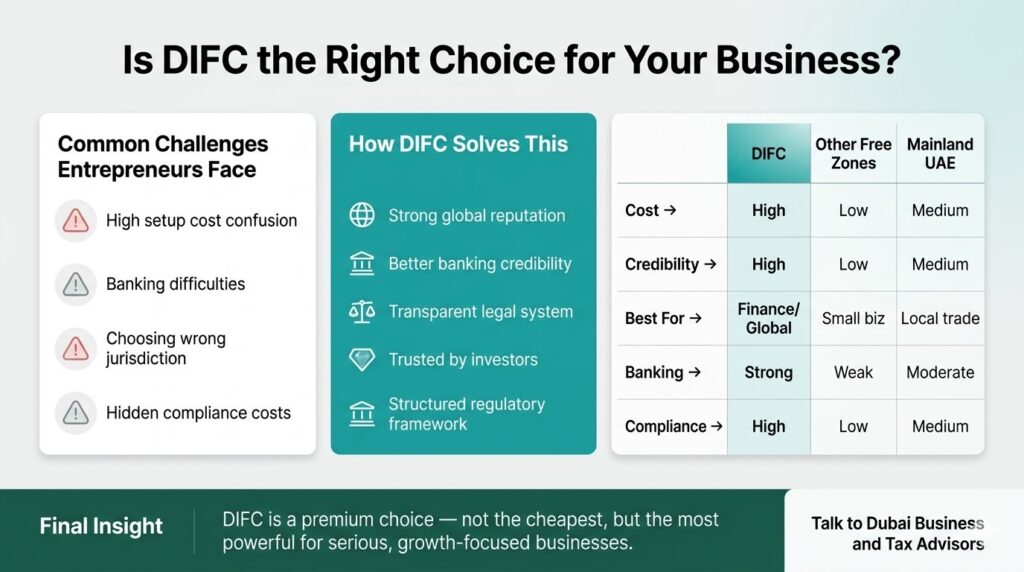
| Factor | DIFC | ADGM (Abu Dhabi) | Mainland UAE | DMCC (Dubai) |
| Legal System | Common Law | Common Law | Civil Law | Civil Law |
| Credibility | Highest (Global) | High (Global) | Local/Regional | High (Trading) |
| Cost | High | High | Moderate | Moderate |
| Best Use Case | Finance, Prestige | Tech, VC, Funds | Local Services | Commodities |
DIFC vs. RAK ICC
Many people compare DIFC to RAK ICC. RAK ICC is an “Offshore” jurisdiction. It is very cheap (~$2,500 setup). However, an offshore company cannot get a UAE residency visa and struggles immensely to open a local bank account. A DIFC holding company is “Onshore,” meaning it has “substance,” grants visas, and is much more “bankable.”
When NOT to Choose DIFC
We often advise clients against DIFC in the following scenarios:
- Small Budget: If $25,000 feels like a significant burden, look at IFZA or Meydan.
- Simple Trading: If you are importing and exporting physical goods, the logistical hurdles of being in a “Financial District” are unnecessary.
- Avoiding Compliance: If you do not want to deal with annual audits or strict data protection filings, DIFC will frustrate you.
Real-Life Use Cases of DIFC Holding Companies
- The Tech Startup: A founder in London sets up a DIFC parent company to hold their IP. They raised $5M from a VC in Singapore. The VC agrees because the investment is protected by DIFC Common Law.
- The Real Estate Investor: An individual owns 10 apartments in Dubai. Instead of holding them in their personal name, they put them under a DIFC holding company to ensure easy succession for their heirs.
- The International Group: A manufacturing group in India uses a DIFC entity as a “Regional HQ” to manage their subsidiaries in Egypt and Saudi Arabia.
Bank Account Opening in DIFC
Opening a bank account in the UAE is famously difficult. However, DIFC companies have a “prestige advantage.” Local banks (like Emirates NBD or Mashreq) and international banks (like HSBC) view DIFC entities as “high quality” due to the strict vetting of the regulator.
Tips for Approval:
- Maintain a physical office (not just a flexi-desk).
- Show a clear source of wealth for the shareholders.
- Keep your website professional and aligned with your license.
- Expect a 4–8 week timeline for banking
FAQS(Frequently asked Questions)
1. What is the cost of setting up a company in DIFC?
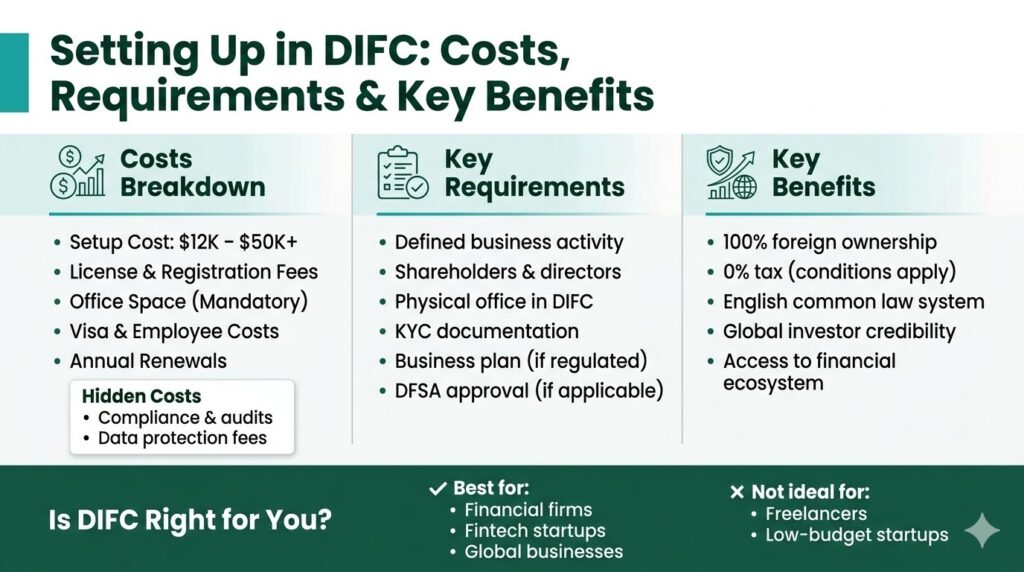
The cost of setting up a company in DIFC generally ranges from USD 12,000 to USD 50,000 or more, depending on your business activity and operational needs. This includes registration fees, licensing, and mandatory office space within DIFC. Additional costs such as visas, compliance, and annual renewals should also be considered, as DIFC is a premium jurisdiction designed for businesses seeking credibility and long-term growth.
2. What are the main requirements for DIFC company formation?
To establish a company in DIFC, you must define your business activity, appoint shareholders and directors, and secure a physical office space within the free zone. You’ll also need to submit KYC documents for all stakeholders. For regulated activities, such as financial services, approval from the Dubai Financial Services Authority (DFSA) is required, along with a more detailed compliance process.
3. What are the key benefits of setting up a company in DIFC?
DIFC offers several advantages, including 100% foreign ownership, a legal system based on English common law, and a highly respected regulatory environment. It also provides access to international investors, financial institutions, and a strong business ecosystem, making it particularly attractive for financial firms, fintech startups, and global businesses.
4. How long does it take to set up a company in DIFC?
The timeline for DIFC company formation typically ranges from 2 to 6 weeks, depending on the type of business and the level of regulatory approval required. Non-regulated businesses can be set up relatively quickly, while regulated entities may take longer due to detailed due diligence and compliance checks.
5. Is a physical office mandatory in DIFC?
Yes, having a physical office space within DIFC is a mandatory requirement for most company types. The size and type of office will depend on your business activity and visa needs. This requirement contributes to the credibility of DIFC companies but also adds to the overall setup cost.
6. Is DIFC the right choice for startups and small businesses?
DIFC is best suited for financial services firms, fintech startups, and professional service providers that require a strong regulatory framework and international credibility. However, for small businesses or freelancers looking for a low-cost setup, other UAE free zones may be more suitable due to DIFC’s higher setup and operational costs.
Final Thoughts
Is DIFC the Right Choice for You?
DIFC is one of the most powerful business jurisdictions in the Middle East ,but it’s not for everyone. It is the right choice if you are building a scalable business, attracting global investors, or need a strong legal and financial framework. However, if your priority is low cost or a simple setup, other options may be more suitable.
The key is making a strategic decision, not a quick one. Choosing DIFC without the right structure can lead to unnecessary costs, while the right setup can unlock long-term growth and credibility.
At Dubai Business and Tax Advisors, we help you assess whether DIFC truly fits your business goals and guide you through the process with clarity and precision.
Get in touch today for a tailored consultation and a 12-month cost forecast based on your business activity.




Post Comment