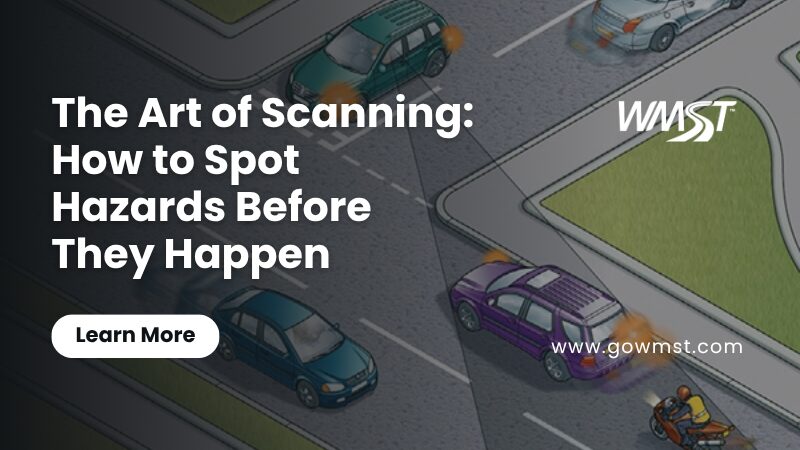
The Art of Scanning: How to Spot Hazards Before They Happen
The most important skill a new driver can learn has nothing to do with their hands on the wheel or their foot on the pedal. It’s their eyes.
There is a fundamental difference between “looking” at the road and “seeing” what’s happening. Looking is passive. Seeing is an active, predictive skill called hazard perception. It’s the art of spotting a potential problem—a “what if”—and having a plan before it ever becomes an emergency.
Mastering hazard perception in WA is the foundation of defensive driving and the one skill that will keep you safer than any high-tech safety feature.
What Is Hazard Perception and Why It Matters
Defensive observation is about answering “what if” questions every second you drive.
- Don’t just see a parked car. See the driver in the seat and ask, “What if they open their door?”
- Don’t just see a ball roll into the street. See the child who is about to run after it.
- Don’t just see a car waiting on a side street. See their wheels turned and ask, “What if they pull out?”
A driver who only reacts to what’s directly in front of them is always one second away from an accident. A driver who scans for hazards is already prepared, calm, and in control.
How to Use the “Far-Near-Mirror” Scanning Pattern
You can’t see hazards if you’re staring at the bumper of the car in front of you. You must keep your eyes moving in a constant, active pattern.
- Look FAR (10-15 Seconds Ahead): Look all the way down the road, to where the road disappears. This is where you will spot the earliest warning signs: a cluster of brake lights, a traffic jam forming, a semi-truck preparing to change lanes. This gives your brain the most time to process.
- Scan NEAR (4-8 Seconds Ahead): After you’ve looked far, scan your eyes left and right back to your immediate “danger zone.” This is where you spot potholes, see the car in front of you tap their brakes, or notice a pedestrian stepping off the curb.
- Alternate check Your MIRRORS and speedometer(Every 5-8 Seconds): In between your “Far-Near” scans, make it a habit to glance at your rearview, side mirrors and speedometer. You must always know what is happening behind you and in your blind spots, not to mention your speed. This pattern—Far, Near, Mirror/speedometer, Far, Near, Mirror/speedometer—keeps you from developing “tunnel vision” and builds a 360-degree bubble of awareness.
Identifying Early Warning Signs on the Road
A “hazard” isn’t just something you’re about to hit. It’s any of these early warnings:
- A car drifting in its lane (likely a distracted or tired driver).
- A driver’s head turning (preparing to change lanes).
- Wheels turned on a parked car (about to pull out).
- Puffs of exhaust from a parked car (it just started and may move).
- A person walking between parked cars.
- Brake lights two or three cars ahead of you.
- Movement out of your periphery.
- Feet on the other side of a parked car.
- A change of color through the windows of a car.
WMST’s Practical Hazard Training for Learners
WMST hazard training isn’t a computer simulation; it’s a real-world skill we build during every minute of your training.
We believe that scanning techniques for drivers are a “muscle” that must be practiced. Our six full hours of actual behind-the-wheel instruction are designed to do exactly this. Our instructors will coach you in real time, pointing out potential hazards and training you to spot them on your own.
This is why we are so strict about the 4-second following distance. This “safety bubble” is the result of good hazard perception. It’s the physical space you create to give yourself the time to react to the hazards you’ve successfully spotted. A driver who scans well never needs to panic-brake.
Conclusion
The art of scanning is what separates a novice driver from a confident, defensive pro. By keeping your eyes moving and training your brain to see “what if” instead of just “what is,” you take control of the road and ensure you can handle any situation safely.
Frequently Asked Questions (FAQs)
What’s the best way to scan while driving?
Use the “Far-Near-Mirror” pattern. Look 10-15 seconds ahead to see traffic patterns and signals. Look 4-8 seconds ahead for immediate dangers. Check your mirrors every 5-8 seconds to know what is beside and behind you. The key is to never let your eyes “rest” on one spot for more than a second.
Do examiners test hazard awareness?
Yes, absolutely. This is a core part of your WA Skills Test score. While there isn’t a “hazard” button to press, the examiner is constantly watching your eyes and your actions. They see if you are scanning at intersections, checking your mirrors, and noticing pedestrians. A driver who fails to see and react to a clear hazard (like a car braking ahead) will fail the test.
How do I avoid missing side hazards?
This is a two-part answer. First, you must use your peripheral vision to catch movement. Second, you must defeat your blind spots. Before you change lanes or make any lateral move, you must perform a head-check (shoulder check). This is the only way to see a car, cyclist, or pedestrian hiding in your blind spot.
What’s peripheral vision and why is it important?
Peripheral vision is what you see out of the “corner of your eye” while looking straight ahead. It’s not clear, but it’s highly sensitive to movement. This is your built-in “early warning system” that will catch a car moving in the next lane or a deer about to run from the side of the road, prompting you to turn your head and look.




Post Comment