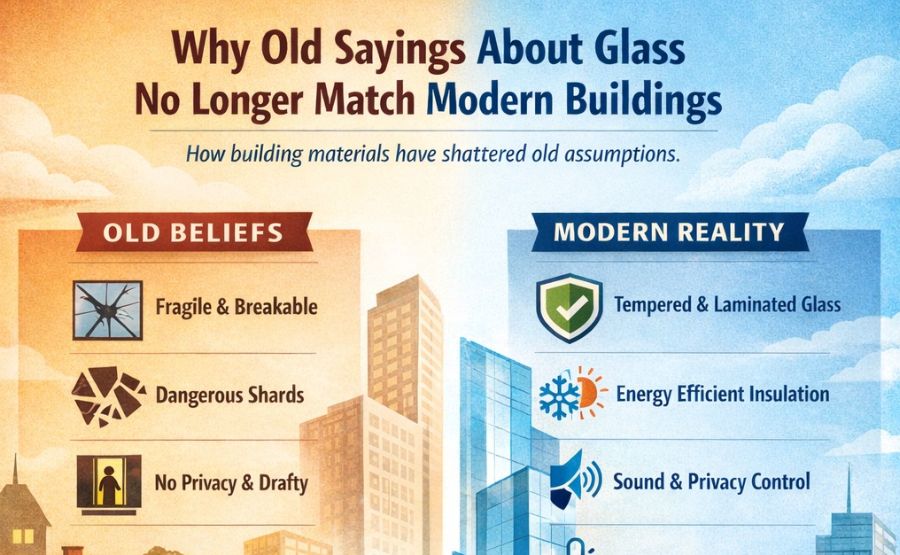
Why Old Sayings About Glass No Longer Match Modern Buildings
For centuries, everyday language has treated glass as a symbol of fragility, danger, and exposure. We still warn people not to “throw stones in glass houses,” describe delicate objects as “fragile as glass,” and talk about “living in a glass house” when privacy feels impossible.
Yet step into a modern city skyline, an airport terminal, or a newly built home and you’ll see something very different: sweeping glass façades, floor-to-ceiling panels, balustrades made entirely of glazing, and energy-efficient windows that stay warm in winter and cool in summer.
So why do these old sayings feel increasingly outdated?
The answer is simple: the glass behind modern buildings is not the glass those sayings were based on. Today’s glazing is engineered, tested, layered, and purpose-built for safety, comfort, and performance. The metaphors survived; the material evolved.
Why Those Sayings Made Sense in the Past
Most traditional proverbs about glass were formed when building technology was far simpler. Domestic windows were typically:
- Single panes
- Thin and uncoated
- Set in putty or timber frames
- Easily cracked by temperature changes or impact
When glass failed, it failed badly—often shattering into sharp shards. Drafts, condensation, and rattling panes were common. In that context, associating glass with weakness and risk wasn’t poetic exaggeration; it was everyday experience.
Those historical conditions shaped three big assumptions:
- Glass breaks easily.
- Broken glass is dangerous.
- Glass offers little privacy or comfort.
Modern construction has spent decades systematically dismantling all three.
What “Glass” Really Means in Modern Buildings
Today, architects and builders rarely specify “just glass.” They specify glazing systems—combinations of thickness, treatments, coatings, laminations, spacers, and framing designed around a building’s needs.
Contemporary glass is expected to deliver:
Structural and Safety Performance
In doors, low-level panels, partitions, and balconies, building regulations commonly require safety glazing. Toughened (tempered) and laminated glass are engineered to reduce injury risk if breakage occurs.
Energy Efficiency
Insulated glazing units, Low-E coatings, gas fills, and warm-edge spacers all help control heat flow. This is why modern homes can feature large glazed areas without becoming freezing in winter or unbearably hot in summer.
For everyday interior or decorative uses, projects often start with something straightforward like custom cut clear glass and then upgrade the specification depending on location, hazard level, and thermal needs.
Acoustic Comfort
Layered glass and carefully designed cavities between panes can dramatically cut traffic and city noise—an outcome unimaginable with old single glazing.
Privacy and Light Control
Frosted finishes, tints, patterned surfaces, and films allow designers to balance openness with discretion. Modern glass architecture is about controlled transparency, not constant exposure.
Five Classic Sayings—Re-Examined Through Modern Glass
1) “Those who reside in glass houses ought not to hurl stones.”
The proverb is moral rather than architectural, but it relies on the image of a house so fragile that one stone could destroy it.
Modern glazing flips that idea. Large façade systems are engineered for wind loads, thermal stress, and impact resistance. The real risk today isn’t that glass is inherently weak—it’s that the wrong type of glass is used in a hazardous location.
In high-risk areas such as shower enclosures, doors, or busy commercial interiors, specifying safety glazing is essential. That’s where modern toughened options come in.
2) “Fragile as glass.”
In casual speech, “glass” still equals “breakable.” But toughened glass is heat-treated to be significantly stronger than ordinary annealed glass and, crucially, designed to break into small granular pieces rather than long sharp shards.
This doesn’t mean glass is indestructible—it means failure modes have been engineered to be safer. That distinction alone makes the old metaphor feel dated.
3) “Living in a glass house” (no privacy).
Older windows meant silhouettes at night, glare during the day, and little visual control. Modern design uses:
- Strategic placement and orientation
- Translucent or patterned finishes
- Films and blinds
- Multi-layer glazing
The result? Spaces that feel bright and open while still protecting occupants from overlooking neighbors or passers-by. Transparency has become a design tool, not a vulnerability.
4) “Glass is always cold.”
Single panes once radiated winter chill into rooms. Today’s insulated glazing and coatings have changed the thermal equation entirely. Properly specified windows can rival opaque walls for comfort.
This is why contemporary glass-heavy buildings—museums, offices, high-rise apartments—can maintain stable indoor temperatures year-round. The cold-glass stereotype lingers mainly because people remember old housing stock, not new performance standards.
For deeper background on how modern window technology boosts energy efficiency, the U.S. Department of Energy offers a useful overview here
5) “Glass is dangerous.”
Historically true—now heavily mitigated. Safety glazing exists precisely to address this concern, particularly where people might fall into or through a panel.
Balustrades, stair screens, and large partitions depend on thickness, edge finishing, fixing systems, and laminated construction. When those elements are properly designed, glass becomes a strong, durable barrier rather than a hazard.
A Practical Checklist for Choosing the Right Glass Today
If old sayings no longer apply, what should guide real-world decisions?
Use this modern-day checklist instead of relying on inherited assumptions:
1) Location
Is the panel in a door, floor-to-ceiling partition, tabletop, balustrade, or window?
2) Risk Level
Could someone collide with it? Fall against it? Is it exposed to wind loads or thermal stress?
3) Safety Requirement
Do regulations or best practice call for toughened or laminated glass?
4) Thickness and Edge Finish
These affect stiffness, longevity, safety, and visual quality.
5) Comfort Goals
Are heat loss, glare, solar gain, or noise reduction priorities?
6) Installation Method
Channels, brackets, fixings, and tolerances matter as much as the glass itself.
Rule of thumb: start with clarity and appearance, then layer in safety and performance until the specification matches the real-world conditions.
Why the Language Hasn’t Caught Up Yet
Proverbs persist because they’re memorable, not because they stay technically accurate. “Fragile as laminated, low-iron, double-glazed, toughened glass” doesn’t roll off the tongue.
The phrases survived because they describe human behavior—hypocrisy, vulnerability, recklessness—not construction science. But when applied literally to buildings, they increasingly misrepresent what glass has become.
If you’re curious about where the famous “glass house” proverb itself came from, Britannica has a concise explanation of its linguistic roots
Bottom Line
Old sayings about glass were born in an era of thin panes and frequent breakage. Modern buildings rely on engineered glazing systems designed for safety, energy efficiency, acoustics, and visual control.
Today’s architectural glass is not a fragile afterthought—it’s a high-performance building material. When specified properly, it can be strong, comfortable, private, and durable.




Post Comment