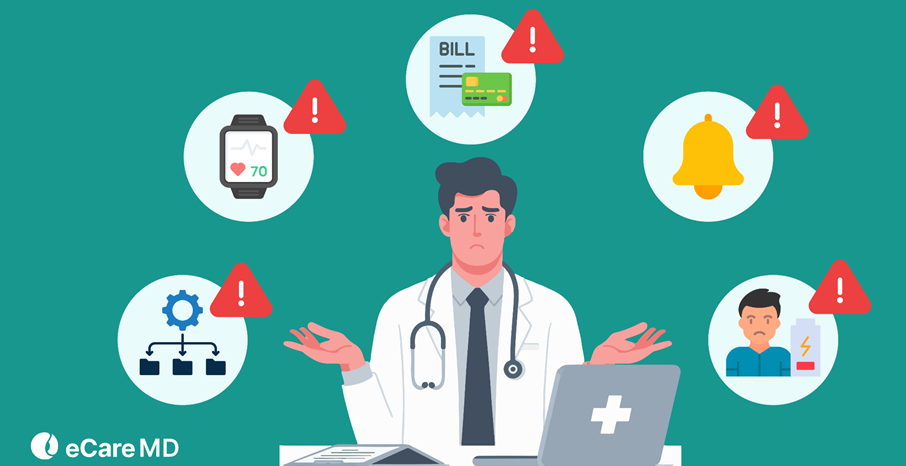
5 RPM Implementation Mistakes Healthcare Providers Should Avoid
As a healthcare professional, you may be aware that Remote Patient Monitoring (RPM) has become a core pillar of modern healthcare.
RPM has transformed from a niche telehealth add-on to a core revenue and care-delivery strategy for many practices across the country.
In fact, Remote Patient Monitoring (RPM) usage in the U.S. has increased more than 30 times. This huge number highlights the fast-growing adoption of RPM in healthcare.
However, don’t let these figures paint the full picture. Many practices still fail within the first 6-12 months, and the main reason is funding. This can create gaps like workflow misalignment, device strategy missteps, billing confusion, alert overload, and poor patient engagement.
To avoid this, it is necessary for you to understand the difference between adopting RPM and implementing it successfully. In simple terms, adoption is the decision, and implementation is the discipline.
Let this blog be your guide to learn about five of the most common RPM implementation mistakes and what to do instead.
Mistake #1: Ignoring Workflow Integration
Treating a program as a standalone initiative is a key error in RPM setup. It means that, treating it as something that runs parallel to, rather than running within existing clinical workflows.
For example, when RPM operates in its own silo, staff toggle between systems, manually transfer data, and duplicate documentation. This can result in an increase in administrative burden and staff burnout. Additionally, it can also make your RPM program feel like extra work instead of a clinical advantage.
Let’s consider, you are a clinician in one mid-size primary care practice and you launch RPM, but you route all device readings to a separate dashboard with no connection to the EHR. Now, you have to check all readings in both systems, record vitals manually, and document RPM interactions outside the normal charting flow.
Feels overwhelming, doesn’t it?
It is obvious that in this case, you and your care team will definitely ignore the RPM dashboard within weeks, not because they do not care, but due to unsustainable friction.
So, how can you avoid this?
Well, the first main thing you should do is embed your RPM into EHR/EMR workflows from day one. All vitals should flow seamlessly into your patient chart, alerts should show within the tools you are using, and time-tracking for billing should happen automatically.
Moreover, you should automate data flow and care coordination, as this eliminates duplicate entries and keeps your staff more focused on patient care. With this, you should also choose a scalable remote health monitoring system that integrates natively with your existing infrastructure.
Mistake #2: Choosing the Wrong Device Strategy
The next major mistake almost every provider goes through is wrong device selection. One thing you should always keep in mind is devices can either make or break your RPM program.
Furthermore, if you over-depend on the cheapest Bluetooth or Wi-Fi options without thinking twice about your patient experience, you can face huge losses in your program growth.
For example, Bluetooth blood pressure cuffs and glucometers are affordable, but they introduce friction that directly undermines adherence.
For your elderly patients, pairing a Bluetooth device with a smartphone app will not be the perfect solution. It will result in connectivity issues, pairing failures, and frustrating app updates.
As a result, patients will stop using the devices, readings will dry up, and you will fail to meet the 16-day transmission threshold required under CPT code 99454. Simply, no data means no billing, and no billing means failure of your entire program.
Let’s explore some key factors to avoid these issues:
How to avoid this:
- You should prioritize cellular and plug-and-play devices that automatically transmit data without requiring a smartphone, Wi-FI, or patient intervention.
- The patient powers on the device, takes a reading, and data flows to the platform over a built-in cellular connection.
- This will enhance adherence rates, minimizes support calls, and ensures consistent data transmission, the backbone of both clinical value and reimbursement eligibility.
Mistake #3: Weak Billing and Compliance Processes
Do you know, behind rising RPM adoption rates, there is one constant thing: reimbursement. However, billing errors are also one of the top reasons behind the failure of many RPM programs.
The RPM billing framework under Medicare involves four CPT codes, each with specific requirements:
| CPT Code | Specific Requirements |
| CPT 99453 | Covers initial setup and patient education on device use (billed once per episode of care) |
| CPT 99454 | Covers device supply and daily data transmission, requiring at least 16 days of readings within a 30-day period |
| CPT 99457 | Reimburses the first 20 minutes of interactive communication and clinical review per calendar month |
| CPT 99458 | Covers each additional 20-minute block of interactive time within the same month |
Your claims get denied when you fail to track time, document interactions, and validate transmission days. And guess what gets worse in all this: Audit risk.
If your billing process cannot keep up with the clinical workflow, you can lose thousands monthly, no matter if your practice delivers excellent RPM care.
How to avoid this:
- Automated billing support is not optional for a sustainable RPM program. Your platform should track clinical time in real-time, flag when patients meet the 16-day device threshold, and generate compliant documentation mapped directly to each CPT code.
- If your current system requires manual time logs or spreadsheet reconciliation, revenue leakage is inevitable.
Mistake #4: Alert Fatigue and Data Overload
RPM programs generate a continuous stream of patient data—blood pressure readings, glucose levels, weight trends, oxygen saturation values.
That data is the clinical engine of the program. But when alert thresholds are poorly configured, data becomes noise rather than a signal.
Alert fatigue is well-documented in clinical settings, and RPM amplifies it. If your system fires a notification every time a blood pressure reading lands slightly above normal, clinicians quickly learn to ignore alerts altogether.
When they ignore the routine ones, they risk missing the critical ones—a dangerously high glucose reading, sudden weight gain in a heart failure patient, or declining oxygen saturation in a COPD patient.
This is not a technology failure. It is a configuration failure—and one of the most overlooked remote patient monitoring implementation challenges.
How to avoid this:
- Set intelligent, condition-specific alert thresholds that reflect clinical reality—not just textbook ranges.
- A blood pressure of 142/90 for an uncontrolled hypertensive patient might not warrant an urgent alert, while the same reading for a previously well-controlled patient could signal a medication issue.
- Prioritized, risk-based notifications ensure your care team focuses on patients who need attention most.
- Where available, leverage automation and AI-driven triage to stratify incoming data so clinical staff spend their time on intervention—not inbox management.
Mistake #5: Poor Patient Engagement and Adherence
You can have the best devices, a perfectly integrated workflow, and flawless billing—but if patients are not actively participating, the program will underperform.
Poor patient engagement is one of the most persistent reasons for RPM program failure, and it usually starts at onboarding.
Too often, patients receive a device in the mail with minimal instructions and no follow-up. They are not told why monitoring matters, how the device works, or what happens with their data.
They feel like passive subjects rather than active participants in their own care. Device usage drops, data becomes inconsistent, and the practice loses both clinical visibility and billing eligibility.
How to avoid this:
- Patient engagement is not a one-time event—it is an ongoing process. Start with a thorough onboarding conversation: explain the purpose of monitoring, demonstrate the device, and set expectations for communication frequency.
- From there, continuous follow-ups via phone, secure messaging, or SMS check-ins reinforce the habit. Patient-friendly devices lower the barrier, but the human connection sustains it.
- When patients understand someone is actually reviewing their data and responding to changes, adherence improves significantly. Treat patients as partners, not passive data sources.
Why RPM Programs Fail: Key Takeaways
The five mistakes above are not isolated—they are interconnected. A poor device strategy drives down adherence. Disconnected workflows make billing harder.
Alert fatigue erodes clinical trust. And weak engagement undermines the entire value proposition of remote monitoring.
A fragmented approach to implementation is one of the critical reasons behind almost every RPM program failure. If you treat RPM as a technology purchase instead of a clinical program, it’s confirmed that your program will collapse.
Successful programs take a holistic, system-level approach—considering the clinical team, the patient, the billing office, and the technology platform as parts of a single integrated system.
Conclusion: Building a Scalable RPM Program
Every RPM implementation mistake that we’ve covered highlights only one thing: treating RPM as a bolt-on rather than a practice transformation. If you want a successful RPM program, you must align with technology, processes, and patient communication from the start.
RPM is not a short-term billing play. It is a long-term strategic investment in value-based care, one that improves patient outcomes, increases practice revenue, and positions your organization for the future of healthcare delivery. But that return only materializes when the implementation is sound.
If you are just getting started with the RPM program, explore our RPM software to learn more about how to build a reliable remote health monitoring system that supports integration, automation, and patient engagement at scale.
FAQs
- What are the most common RPM implementation mistakes in healthcare?
The most common mistakes include failing to integrate RPM into existing EHR workflows, selecting devices that patients struggle to use, neglecting billing and compliance documentation, poorly configuring clinical alerts, and not investing in ongoing patient engagement and education.
- How do RPM setup errors impact patient adherence?
RPM setup errors—particularly choosing Bluetooth-dependent devices or providing inadequate onboarding—create friction for patients. When devices are difficult to pair or come without clear instructions, patients disengage quickly, leading to inconsistent data and missed billing thresholds.
- Why do many RPM programs fail in the first year?
Most RPM programs fail because of a fragmented implementation approach—technology, workflows, billing, and patient engagement are treated as separate initiatives rather than components of a single integrated program. Without alignment across these areas, programs struggle to maintain data consistency and reimbursement.
- How can a remote health monitoring system improve RPM workflows?
A well-designed remote health monitoring system integrates directly with EHR platforms, automates vitals data flow into patient charts, tracks clinical time for billing, and surfaces prioritized alerts—eliminating manual data entry and ensuring consistent documentation for CMS compliance.
- What are the biggest billing challenges in RPM implementation?
The biggest challenges include accurately tracking the 16-day device transmission requirement for CPT 99454, documenting the 20-minute interactive time threshold for CPT 99457, and maintaining audit-ready records across all four RPM CPT codes (99453, 99454, 99457, 99458).
- How can providers reduce alert fatigue in RPM programs?
Providers should configure condition-specific alert thresholds rather than using generic ranges, implement risk-based notification prioritization, and leverage AI-driven triage tools to filter non-critical data so care teams focus on clinically significant changes.
- What strategies improve patient engagement in remote patient monitoring?
Effective strategies include thorough device onboarding with live demonstrations, regular follow-up communication via phone or secure messaging, using cellular plug-and-play devices that require minimal patient effort, and framing monitoring as a partnership where patients see their data driving real clinical decisions.
- How can healthcare providers avoid RPM program failure reasons?
Providers should take a holistic implementation approach addressing workflow integration, device strategy, billing automation, alert configuration, and patient engagement as interconnected components. Choosing a platform that supports EHR integration, automated compliance tracking, and patient-friendly devices is the most effective way to mitigate common causes of RPM program failure.




Post Comment