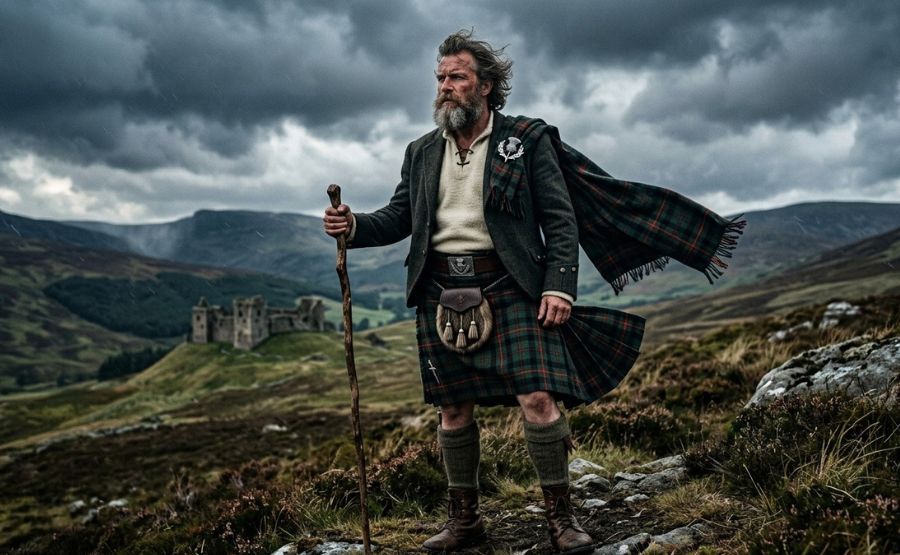
Armstrong Tartan: The Outlaw Clan Story Behind Scotland’s Most Rebellious Pattern
Most Scottish clans wear their history with pride. The Armstrongs wear theirs with a slight smirk.
Of all the registered clans and tartans in Scotland — and there are over 25,000 patterns in the official register today — few carry a story as wild as the Armstrongs. They were one of the most feared border families in Scottish history. They had a reputation that extended into England, France, and as far as the courts of Spain. They were officially declared outlaws by the King of Scotland himself. And against all that, they survived, kept their tartan, and produced one of the most striking dark-and-bold patterns in the entire register.
If you have Armstrong blood in your family — and you’d be surprised how many people do, especially in the United States and Northern Ireland — wearing the Armstrong tartan isn’t just a fashion choice. It’s a small act of carrying forward one of the most dramatic clan stories in Scottish history.
Here’s the full story behind the pattern.
The Borderlands and the Reiver Clans
To understand the Armstrongs, you have to understand the Anglo-Scottish border in the 13th to 17th centuries.
The border itself was a contested zone — neither fully Scottish nor English in practical terms, despite political claims from both sides. The kings of Scotland and England were almost continuously at war, and the families living in the border region had to fend for themselves. Crops were burned. Cattle were stolen. Villages were raided.
In response, a particular kind of family emerged: the Border Reivers. These were powerful clans who organized themselves around mutual protection, livestock, and — when other options ran out — raiding their neighbors and across the border into England.
The Armstrongs were the most powerful of the Reiver clans.
At their peak, the Armstrong family could field 3,000 fighting men on horseback. They controlled significant territory in Liddesdale and the western border regions. They were so powerful that the Scottish Crown sometimes tolerated their raiding because they served as a buffer against English military incursions.
But that tolerance had limits.
Johnnie Armstrong and the Hanging at Carlanrig
In 1530, King James V of Scotland decided the Armstrongs had grown too powerful. He summoned Johnnie Armstrong of Gilnockie, the most famous Armstrong chief, to a meeting under the pretense of negotiating peace.
The legend, told in a famous Scottish ballad, says Johnnie arrived with 50 of his men in fine array — wearing armor, gold chains, and richly dyed clothing. The king saw this display as proof that Johnnie was wealthier and prouder than any subject ought to be. The king ordered Johnnie and most of his men hanged on the spot, at a place called Carlanrig.
According to the ballad, Johnnie’s last words to the king were:
“I have asked grace at a graceless face,
But there is none for my men and me.”
The hanging at Carlanrig devastated the Armstrong clan and is still commemorated in Scottish historical memory. The Armstrongs were officially outlawed and proscribed by the Scottish Crown, which means — in terms of clan history — they were one of the few major clans formally branded as outlaws by their own king.
The story echoes through Scottish ballads, history, and folklore. And it’s exactly the kind of dramatic, defiant origin story that gives the Armstrong tartan its character.
The Armstrong Tartan: What the Pattern Actually Looks Like
The modern Armstrong tartan, registered in the Scottish Tartan Authority’s records, has the following characteristics:
- Dominant green as the base color, but a darker forest green than many clan tartans
- Strong navy blue stripes running through
- Bold red stripes — fewer but more pronounced than in most green-based tartans
- White (or off-white) accent lines providing high-contrast definition
- Black overcheck in places, adding visual depth
The overall effect is darker and more aggressive than tartans like Mackenzie, Stewart, or Cameron. The red stripes pop sharply against the green and navy base. There’s something visually defiant about the pattern — appropriate for a clan whose history was built on standing apart from royal authority.
There are also several variants:
- Armstrong Modern — Brighter, cleaner colors, the most common contemporary version
- Armstrong Ancient — Softer, more muted tones, suggesting natural plant dyes
- Armstrong Hunting — Darker overall, with more brown and forest tones for outdoor use
- Armstrong Dress — Lighter base color (often white or cream) for formal events
A traditional Armstrong tartan kilt most commonly uses the Modern or Ancient variant, depending on the wearer’s preference for vibrancy.
Who Can Wear the Armstrong Tartan?
This question comes up constantly, and the answer is more nuanced than “only people with Armstrong blood.”
Strong Armstrong Family Connection
If you have Armstrong, Crozier, Forster, Fairbairn, Grozer, Croser, Armistead, or several other related surnames in your family tree, the Armstrong tartan is appropriate to wear without question. The clan recognizes a wide net of allied families and septs.
Distant or Possible Armstrong Connection
If your ancestors are from the Anglo-Scottish border region but you can’t trace a specific clan, the Armstrong tartan is still acceptable as a connection to that region’s heritage.
No Armstrong Connection at All
Wearing a clan tartan you have no family connection to is generally considered impolite in Scottish heritage circles. You won’t be stopped, and you won’t necessarily offend anyone, but knowledgeable Scots will notice.
The Armstrong clan has a global reach. The American astronaut Neil Armstrong wore a piece of Armstrong tartan to the Moon — he had ancestral connections through his Northern Irish lineage, where many Armstrong descendants migrated during the Plantation of Ulster. If your family has Northern Irish or Scotch-Irish American roots, you may have Armstrong connections you didn’t know about.
A quick family genealogy check can usually reveal whether the Armstrong tartan is rightfully yours.
How to Wear the Armstrong Tartan
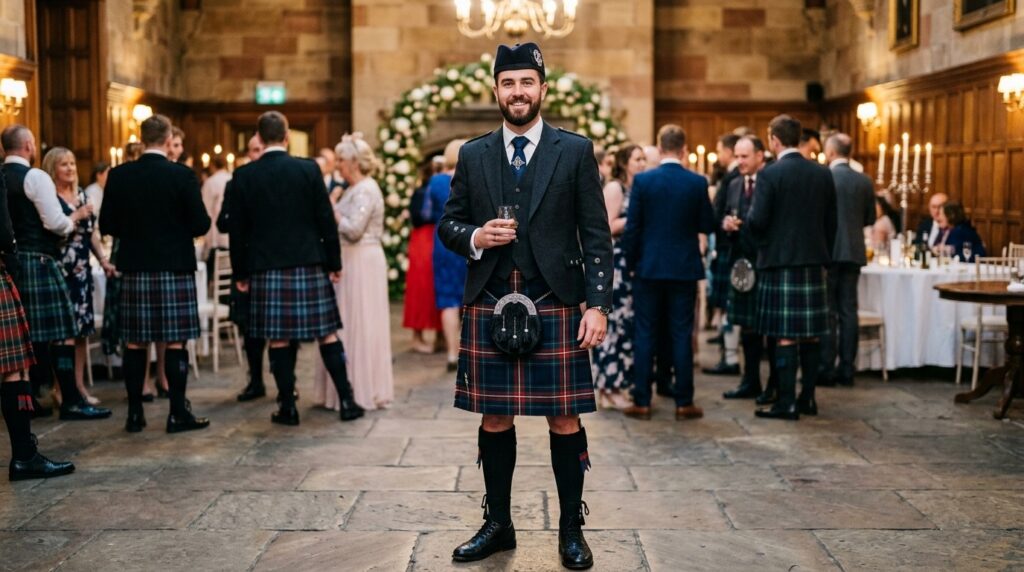
The pattern is bold, which means styling has to work with the kilt rather than against it.
Best Paired With
- Black Argyll or Prince Charlie jacket for formal events
- Charcoal or black waistcoat to anchor the dark green base
- Cream kilt hose with red flashes to pick up the red in the tartan
- Black ghillie brogues
- Black leather sporran with chrome or silver fittings — avoid heavy ornamentation that competes with the bold tartan
Avoid
- Bright accent colors that fight with the tartan’s existing reds and blues
- Brown leather accessories with formal Armstrong wear (the tartan reads cooler than warmer)
- Highly decorative sporrans (the kilt is the focal point)
- Patterned ties (a solid tie or simple bow is better)
The Armstrong tartan is what stylists would call a “high-impact pattern” — it draws the eye on its own. Everything else in the outfit should support, not compete.
The Modern Armstrong Identity
The Armstrong clan has experienced a significant resurgence in the past few decades, especially among descendants in North America and Australia.
The Clan Armstrong Trust maintains the family’s heritage sites, including Gilnockie Tower in the Scottish Borders — one of the few surviving Armstrong strongholds. The trust runs an annual gathering, and the Armstrong family is represented at the major Highland Games circuit worldwide.
The motto of the clan is “Invictus Maneo” — Latin for “I remain unvanquished.” It’s an obvious reference to the clan’s survival despite being officially outlawed by their own king. Wearing the Armstrong tartan today is, in a small way, fulfilling that motto.
For descendants who weren’t aware of their Armstrong heritage until adulthood — and there are many — wearing the tartan can be a significant emotional connection to a piece of family history that often went unspoken in earlier generations.
Wider Context: Where the Armstrong Tartan Sits Among Clans and Tartans
In the broader context of Scottish clans and tartans, the Armstrong tartan sits in an interesting category.
Universal Tartans
Universal tartans like Black Watch and Royal Stewart can be worn by anyone. They’re cultural property, not family property.
Geographic District Tartans
Geographic district tartans like Edinburgh or Lothian represent areas, not bloodlines.
Clan Tartans
Clan tartans like Armstrong, Mackenzie, MacDonald, and Cameron are family-specific. They carry meaning for descendants and are generally reserved for them.
The Armstrong tartan is firmly in the clan category, but with a few characteristics that make it distinctive:
- It has a more dramatic origin story than most clan tartans
- It has wider name recognition due to Neil Armstrong’s symbolic connection
- It has more allied surnames (septs) than most clans, expanding the eligible wearer base
- The pattern itself is bolder and more visually arresting than many clan tartans
For someone choosing a clan tartan to wear, the Armstrong stands out as a strong, characterful option — assuming the family connection is there.
Common Mistakes With Armstrong Tartan
A few errors come up with first-time Armstrong tartan wearers:
Choosing a Sporran That’s Too Ornate
The Armstrong pattern is already loud. A heavily-decorated sporran turns the outfit chaotic. Plain black or dark brown leather with simple metalwork is the right call.
Pairing With a Brightly Colored Shirt or Tie
The reds in the tartan need to be the strongest red in the outfit. A bright red tie steals focus and creates visual confusion.
Wearing It to Events Where It Would Be Inappropriately Bold
A funeral, for example, generally calls for the more subdued Black Watch. Save the Armstrong for occasions where the dramatic statement is welcome — weddings, Burns Night, family gatherings, formal dinners.
Buying a Low-Quality Version
The Armstrong’s depth of color depends on the wool quality and weave. A cheap polyester print loses the layered visual depth and looks cartoonish instead of bold.
Frequently Asked Questions
Is the Armstrong Tartan a Real Registered Tartan?
Yes. It’s registered with the Scottish Register of Tartans and has been recognized for over a century in its current form.
Can I Wear the Armstrong Tartan if My Surname Is Similar but Not Exactly “Armstrong”?
Possibly. Recognized septs include Crozier, Forster, Fairbairn, Armistead, Croser, Grozer, and several others. Check the Clan Armstrong Trust’s official list for the full set.
What’s the Difference Between Armstrong Modern and Armstrong Ancient?
Modern uses brighter, cleaner colors. Ancient uses softer, muted tones meant to evoke natural plant dyes. Both are equally valid; the choice is purely aesthetic.
Did Neil Armstrong Actually Take Armstrong Tartan to the Moon?
Yes. Neil Armstrong took a small piece of Armstrong tartan with him on Apollo 11. It was later returned to the Clan Armstrong Trust and is held as a relic.
Can Women Wear the Armstrong Tartan?
Yes. Women’s kilts, sashes, scarves, and skirts are all available in Armstrong tartan and are equally appropriate for female descendants.
What Does the Armstrong Clan Motto Mean?
“Invictus Maneo” — “I remain unvanquished.” A direct reference to the clan’s survival after being outlawed by King James V.
The Armstrong tartan isn’t a quiet pattern. It comes with one of the most dramatic origin stories in Scottish heritage, and the visual design carries that boldness forward. If your family carries Armstrong blood, wearing the tartan today is a small but meaningful way of keeping a 500-year-old story alive.



Post Comment