CTEM: Continuous Threat Exposure Management
Continuous Threat Exposure Management (CTEM) is a forward-looking security program designed to help organizations systematically find, assess, and address weaknesses across their entire attack surface — on an ongoing basis. Rather than being a standalone tool or technology, CTEM is a structured framework that keeps security efforts aligned with the real-world threat landscape. It works by combining continuous scoping, vulnerability discovery, risk-based prioritization, control validation, and coordinated remediation into a single repeating cycle.
The reasoning is simple: organizations that regularly map their exposures, understand which ones are most dangerous, verify whether their defenses would hold against actual attack scenarios, and fix problems in a structured way will be far better positioned against adversaries than those relying on annual assessments or reactive patching. Gartner, which formally introduced CTEM as a strategic cybersecurity priority, projected that organizations building their security investments around this model could reduce breach likelihood by as much as two-thirds by 2026. Adoption is accelerating — a recent Gartner survey found that roughly 71% of organizations stand to benefit from this approach, with 60% already exploring or implementing it.
The 5 stages of the Continuous Threat Exposure Management lifecycle
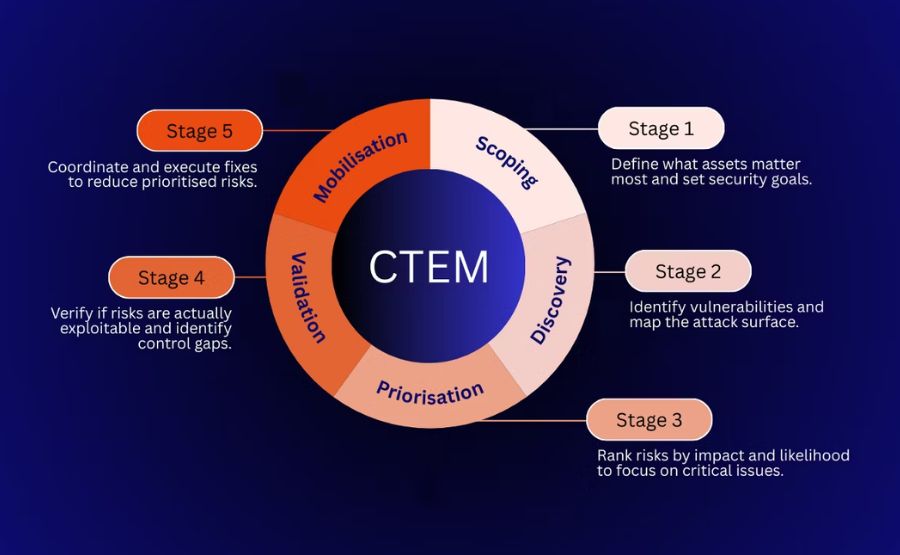
CTEM operates as a five-phase cycle. Each stage feeds into the next, and the process repeats continuously to ensure defenses keep pace with changing threats.
1. Scoping
Before anything else, organizations need to define what they’re protecting. This phase involves mapping the external attack surface and assessing risks associated with SaaS platforms and software supply chains. Crucially, it requires collaboration between business and security teams to identify which systems, data, and processes are most critical — and why. Each new cycle of CTEM may refine or expand this scope as the organization evolves.
2. Discovery
With the scope defined, teams move to systematically identifying the assets within it — infrastructure, networks, applications, and sensitive data — and cataloguing weaknesses such as misconfigurations, software vulnerabilities, and process gaps. Each finding is assessed and categorized by the type of risk it introduces, giving analysts a structured picture of where weaknesses exist and what they affect.
3. Prioritization
Not every discovered vulnerability deserves immediate attention. This stage focuses on evaluating how likely each exposure is to be exploited — whether or not compensating controls are in place — and ranking findings accordingly. Low-probability risks are deprioritized, freeing security teams to concentrate their limited resources on what’s most likely to lead to harm. This shifts the model from chasing volume to pursuing impact.
4. Validation
Rather than assuming a discovered vulnerability poses a real threat, CTEM requires teams to test whether it does. This involves launching simulated attacks against identified exposures to measure how effective existing defenses actually are. Validation also examines whether attackers could use initial access to move laterally toward critical systems. A wide range of techniques — breach simulations, adversary emulation, red teaming exercises — are used to assess both preventive and detection controls. The goal is to confirm that the response and remediation processes are adequate, not just theoretically sound.
5. Mobilization
The final phase translates validation findings into action. Teams take corrective steps based on the business implications of what was discovered. Remediation is most effective when it’s near-frictionless — supported by clear, structured information and collaborative workflows that allow quick handoffs between security, IT, and leadership. The outputs of mobilization also feed back into the next round of scoping, making the cycle self-improving over time.
Core components of the CTEM framework
Understanding the five stages explains what CTEM does. Knowing its underlying components explains how it’s done. Effective CTEM programs rely on several interconnected capabilities:
1: Comprehensive asset visibility
Security teams cannot manage what they cannot see. Continuous asset discovery — including external attack surface management (EASM) to track internet-facing systems and shadow IT — forms the foundation of any CTEM program. With only 17% of organizations able to identify the majority of their digital assets, building and maintaining a complete, current inventory is both essential and often underestimated.
2: Threat intelligence & context
Raw vulnerability data becomes far more actionable when enriched with context. Threat intelligence tells teams which weaknesses are being actively exploited in the wild, which threat actors are targeting their sector, and which of their assets are most attractive to attackers. Combined with knowledge of asset criticality established during scoping, this context ensures that the most dangerous exposures receive the most urgent attention.
3: Risk-based prioritization mechanism
A well-functioning CTEM program depends on an intelligent system for ranking exposures by real-world impact. This mechanism — whether a dedicated platform or an advanced vulnerability management tool — draws on threat feeds, asset value, exploitability data, and other factors to separate the critical few issues from the overwhelming many. Crucially, it must be dynamic, updating automatically as new threats emerge or environments change.
4: Continuous security validation
One of CTEM’s defining features is that it does not rely on assumed risk. Instead, security controls are continuously tested through simulated attacks — using tools like breach and attack simulation (BAS), automated red teaming, and adversary emulation frameworks such as MITRE ATT&CK. This validation answers the question “does this vulnerability actually represent a threat in our environment?” and confirms whether detection and response mechanisms would activate as expected.
5: Orchestrated remediation & collaboration
Findings are only valuable if they lead to action. This component covers the workflows, integrations with ticketing systems, cross-team coordination, and executive reporting that turn security insights into actual fixes. Dashboards that show risk trends over time, metrics that speak to business leaders, and clear task assignments for technical teams are all part of making remediation stick. Without this, CTEM insights risk dying in a spreadsheet.
6 benefits of implementing CTEM solutions
Organizations that successfully implement CTEM move from periodic, reactive security management to a continuous, proactive posture. The benefits span technical, operational, and strategic dimensions:
1. Business alignment
Security findings are translated into business-relevant language, enabling more informed decisions at the executive level and stronger alignment between security teams and organizational goals.
2. Continuous validation
Rather than relying on annual audits, CTEM uses ongoing simulations and exercises to keep a real-time pulse on whether defenses are working as intended.
3. Efficiency at scale
Automation handles discovery, correlation, and validation tasks that would otherwise require large teams, making comprehensive coverage achievable even in resource-constrained environments.
4. Actionable insights
CTEM doesn’t just highlight gaps — it provides prioritized, context-rich guidance and integrated remediation workflows that accelerate fixing what matters most.
5. Measurable resilience
Trend reports and risk metrics give organizations quantifiable evidence of improving security posture, turning abstract security investments into demonstrable outcomes.
6. Consolidated visibility
Rather than adding fragmented tools, well-designed CTEM platforms unify multiple functions — discovery, validation, prioritization, remediation — into connected workflows that reduce operational overhead.
The ultimate goal of CTEM
The overarching aim of CTEM is security posture optimization — not as a one-time achievement, but as an ongoing state of improvement. Its cyclical structure means lessons learned in each round inform the next, and continuous refinement becomes embedded in how the organization operates.
This urgency is underscored by a difficult reality: despite significant investment in scanning tools and defensive technologies, most organizations still struggle to prove their resilience or react fast enough when gaps are identified. Security teams are routinely overwhelmed by noisy alerts, misdirected by poorly prioritized findings, and surprised by defensive controls that underperform under real attack conditions. According to the Logicalis 2025 CIO Report, 88% of organizations experienced security incidents despite meaningful security spending.
CTEM directly addresses this gap. By grounding security activity in validated, prioritized, business-aligned intelligence, it helps security operations centers shift from reacting to noise to acting on what genuinely matters — building organizations that are not just defended on paper, but demonstrably resilient in practice.
The Role of Professional CTEM in Cyberproof
Professional CTEM services, like those delivered by Cyberproof, are instrumental in helping organizations move beyond theoretical security frameworks and put Continuous Threat Exposure Management into genuine practice. By weaving together advanced threat intelligence, round-the-clock monitoring capabilities, and seasoned expert analysis, Cyberproof equips businesses to surface and rank real-world risks with far greater precision than most internal teams can achieve alone. Their managed approach keeps remediation timelines short, ensures security controls are continuously put to the test, and maintains alignment with a threat landscape that never stops shifting — all without placing unsustainable demands on an organization’s own security staff.
Conclusion
Continuous Threat Exposure Management (CTEM) represents a major shift from reactive cybersecurity toward a continuous, intelligence-driven defense strategy. By combining ongoing discovery, risk-based prioritization, real-world validation, and coordinated remediation, CTEM enables organizations to focus on the exposures that truly matter instead of being overwhelmed by endless alerts and vulnerabilities. As cyber threats continue to evolve in speed and sophistication, businesses need a framework that adapts just as quickly. Professional CTEM services from companies like Cyberproof strengthen this approach by providing the expertise, automation, and operational support required to maintain resilience at scale. Ultimately, CTEM is not just about finding weaknesses — it is about continuously proving, improving, and sustaining an organization’s ability to withstand real-world attacks in an increasingly complex digital environment.




Post Comment