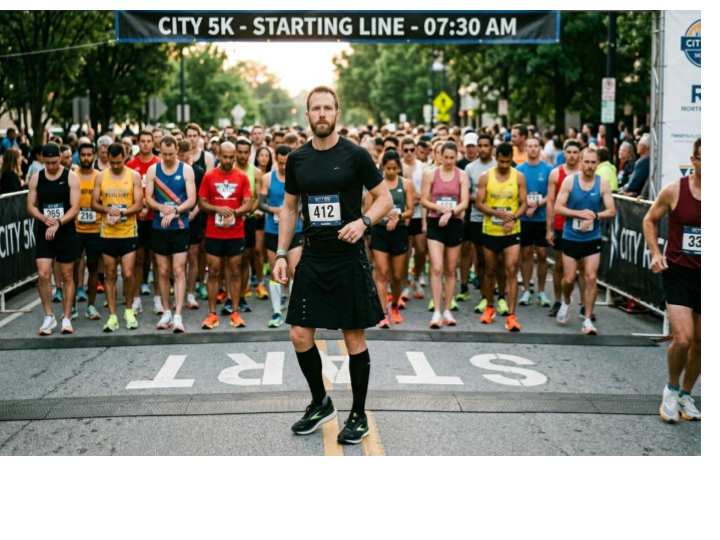
I Tried Running a 5K in a Sport Kilt — Here’s the Athletic Kilt Outfit That Actually Works
There’s a long-running joke in kilt-wearing circles that traditional Scottish kilts are surprisingly athletic — that Highland soldiers used to march thirty miles in them, that Highland Games athletes still throw cabers and stones in them, and that the kilt is somehow more functional than modern pants. The joke isn’t entirely wrong, but it’s only half right.
The full truth is that a heavyweight 8-yard wool kilt is not the same garment as a modern sport kilt, and pretending otherwise leads to the kind of disappointment I was about to experience.
I’d just bought a sport kilt — the modern athletic version — and I wanted to know whether it was actually built for sport, or whether “sport” was a marketing word slapped on a slightly modified casual kilt. The cleanest test I could think of was a 5K run.
So one Saturday morning, I laced up my running shoes, put on the sport kilt, and lined up at the start of a local 5K race.
Here’s exactly how it went, what worked, and the complete athletic kilt outfit I’d actually recommend after the experience.
The Sport Kilt vs Traditional Kilt: What Actually Differs
Before the run, here’s what made me think the test was worth doing.
A traditional wool kilt weighs 4 to 5 pounds. A sport kilt weighs about 12 ounces — roughly the weight of a pair of cargo shorts. That alone is a massive difference.
Beyond weight, sport kilts are built differently:
– Lightweight technical fabric — usually a polyester-cotton blend or pure poly, designed to wick moisture
– Velcro closure instead of leather buckles, allowing for quick adjustments
– Shorter length typically — sitting at or just above the knee rather than mid-knee
– Reduced pleat depth— the back pleats are present but flatter, with less fabric volume
– Elasticated waistband option in some models, for full athletic flex
– Wash-and-wear construction — machine washable, fast-drying
The traditionalist might call this “not a real kilt.” Practically speaking, it’s a kilt that can do what a real kilt physically can’t.
The First Mile: Surprises
The first thing that surprised me was how normal it felt.
I’d half-expected the kilt to flap dramatically with each stride, swing into my legs, or generally feel like I was running with a flag tied around my waist. None of that happened.
The reduced pleat depth meant the back stayed close to my legs without the heavy swing of a wool kilt. The lightweight fabric moved with my body rather than against it. By 200 meters in, I’d basically forgotten I was wearing a kilt instead of running shorts.
What I noticed:
– Air circulation was better than running shorts. This is the legitimately surprising one. With kilt hose pulled up and the kilt itself open at the bottom, there was constant cool airflow that no pair of shorts can match.
– No chafing. The lightweight technical fabric didn’t catch or rub the way certain athletic shorts can.
– No restriction on stride. I have a long running stride, and a fitted pair of shorts can sometimes feel limiting. The kilt had unlimited give.
The Second Mile: The Actual Problems Show Up
Around the 1.5-kilometer mark, the practical issues started.
Wind became a real problem. A traditional wool kilt has the weight to stay put in a stiff breeze. The lightweight sport kilt does not. Running into a headwind, the front apron lifted slightly with each gust. Not enough to expose anything, but enough to be a constant low-level distraction. I found myself instinctively reaching down to press the apron flat every minute or so.
Pockets I didn’t have became pockets I needed. Most sport kilts have minimal or no pockets — the focus is on freedom of movement, not utility. I had no place for my phone, no place for car keys, no place for the chip timer band that wasn’t already on my wrist. A small running belt solved this in retrospect, but I hadn’t worn one.
The Velcro closure shifted. About 2 kilometers in, the Velcro had slowly worked its way looser. The waistband had dropped about an inch. I had to stop, adjust, and re-tighten — losing about 30 seconds. This wasn’t a fault of the kilt exactly, but it taught me the importance of tightening Velcro closures more aggressively at the start.
The Third Mile: When the Kilt Started Winning
By kilometer 3, the temperature was rising and other runners around me were visibly starting to overheat. Their shorts and t-shirts had started darkening with sweat. Their leg lines showed where the shorts had ridden up and bunched.
The kilt, meanwhile, was still doing its thing — air moving freely, no chafing, no restriction. The technical fabric I’d doubted earlier was earning its keep.
This was the moment I genuinely understood why some Highland athletes prefer to compete in sport kilts. In sustained physical activity in moderate-to-hot weather, the kilt’s open architecture beats most shorts.
I finished the 5K in roughly my normal time. Not faster — but not slower either, which alone validates the sport kilt as a legitimate athletic garment rather than a novelty.
Building a Sport Kilt Outfit That Actually Works
Based on what worked and what didn’t, here’s the athletic kilt outfit I’d recommend for anyone trying this:
The kilt itself
A genuine technical-fabric [sport kilt](https://fashionkilt.com/products/endurance-elite-sport-kilt) — not a casual cotton kilt being misused for sport. The differences in fabric weight and pleat depth genuinely matter for athletic use.
The top
A standard moisture-wicking athletic shirt or long-sleeve. Don’t try to wear a button-down or anything traditional with a sport kilt — the contrast looks confused. Athletic shirt with athletic kilt is the correct visual pairing.
Underwear
Compression shorts or running briefs. The traditional “regimental” approach to wearing a kilt does not apply to athletic use. You’ll regret it within the first kilometer if you skip this. Compression shorts also reduce the wind-lift problem on the front apron significantly.
Hose / socks
Running socks, not traditional kilt hose. Wool kilt hose is too warm and too thick for actual running. Standard athletic crew socks or low-cut running socks. Save the wool hose for non-athletic kilt-wearing.
Belt
If your sport kilt has Velcro, a belt is optional but useful as a backup if the Velcro slips. A simple webbing belt over the kilt waistband adds security without limiting movement.
Pocket / pouch system
This is the upgrade that transforms the sport kilt for actual sport use:
– A small running belt or fanny pack worn over the kilt waistband
– Or a hydration vest with chest pockets
– Or athletic shorts underneath with side pockets
Without a pocket system, you can’t carry anything, and that limits the kilt to true sprint-only use.
Footwear
Whatever your sport requires. Running shoes for running. Cleats for sport. Cross-trainers for the gym. The kilt doesn’t dictate footwear the way traditional kilts do — there’s no “ghillie brogues for athletics” rule.
When the Sport Kilt Actually Beats Traditional Athletic Wear
After the 5K and several follow-up tests at the gym, on hikes, and during a charity Highland Games event, here’s where I’d recommend the sport kilt over standard athletic clothing:
Highland Games events — This is where sport kilts originated. Throwing, running, and pulling events all benefit from kilt mobility, and the cultural fit is obvious.
Hiking in moderate weather — The airflow advantage is real, especially on long climbs in 65 to 80°F weather.
Outdoor festivals and runs — 5Ks, charity walks, fun runs, color runs. The novelty alone gets you positive attention, but the practical performance is also legitimate.
Hot weather workouts — Outdoor circuit training, summer boot camps, beach workouts. Heat dissipation through an open garment is a real performance edge.
Adventure racing and obstacle courses — Surprisingly capable here. Mud washes off easily, the fabric dries fast, and there’s no chafing during repeated obstacle navigation.
When the Sport Kilt Is Actually a Bad Idea
Equally honestly, here’s where the sport kilt fails:
High-wind conditions — Cycling, fast downhill running, sustained windy conditions. The lightweight fabric can’t manage strong air.
Contact sports — Football, rugby, MMA. The kilt format is wrong for grappling or impact sports regardless of fabric.
Cold weather — A sport kilt with bare legs in 40°F is just cold. Layering kilt hose and compression tights helps but defeats some of the airflow advantage.
Indoor gym workouts where you’re around equipment — Squats with weights, rowing machines, kettlebell swings. The fabric can catch on equipment in ways athletic shorts won’t.
Anywhere modesty is a concern — High-bend exercises like deep squats, certain yoga positions, etc. A sport kilt with proper compression underneath handles this fine, but it’s something to be aware of.
Building the Full Athletic Kilt Outfit
If you want a complete kilt outfit for athletic use — something genuinely wearable for everything from a fun run to a Highland Games competition — here’s the working list:
1. Sport kilt in a technical fabric, fitted at the natural waist
2. Compression shorts or running briefs underneath
3. Moisture-wicking athletic shirt
4. Standard running socks
5. Sport-appropriate footwear
6. Small running belt or hydration vest for carrying gear
7. Optional: webbing belt or sash for extra waistband security
Total cost for the full athletic setup is around $200 to $300, with the kilt itself being the most expensive single piece. Compared to the cost of fully traditional Highland Games attire, this is a significant savings — and dramatically more versatile for everyday athletic use.
Frequently Asked Questions
Q:Can I wear a sport kilt for casual non-athletic events?
Yes, but it’ll read as athletic. Pair it with athletic-styled tops and shoes. Don’t try to dress it up formally — the lightweight fabric and modern construction don’t suit formal styling.
Q:Do sport kilts come in tartan patterns?
Some do. Many brands offer sport kilts in modern tartans printed on technical fabric. Traditionalists may find this jarring — woven tartan and printed tartan are different — but it’s a legitimate option.
Q:What’s the difference between a sport kilt and a utility kilt?
Sport kilts focus on lightweight athletic performance. Utility kilts focus on practical daily wear with heavy fabric and cargo pockets. Sport kilts run, utility kilts work.
Q:Can I wear a sport kilt to a Scottish wedding?
No. Sport kilts are athletic gear. Use a traditional wool kilt for any formal Scottish event.
Q:How do I clean a sport kilt?
Most are machine washable on cold, hung to dry. Always check the specific brand’s care instructions, but the wash-and-wear simplicity is one of the sport kilt’s advantages.
Q:Are sport kilts comfortable for women too?
Yes. Many sport kilt brands offer women’s cuts, and sport kilts are popular among female Highland Games athletes and Celtic-themed race participants.
—
The sport kilt isn’t a costume, and it isn’t a gimmick. After 5 kilometers of actual running and several follow-up sessions, I’d put it firmly in the “legitimate athletic gear” category — with the caveats above. If you want to combine kilt-wearing with an active life, this is the piece that makes it possible.



Post Comment