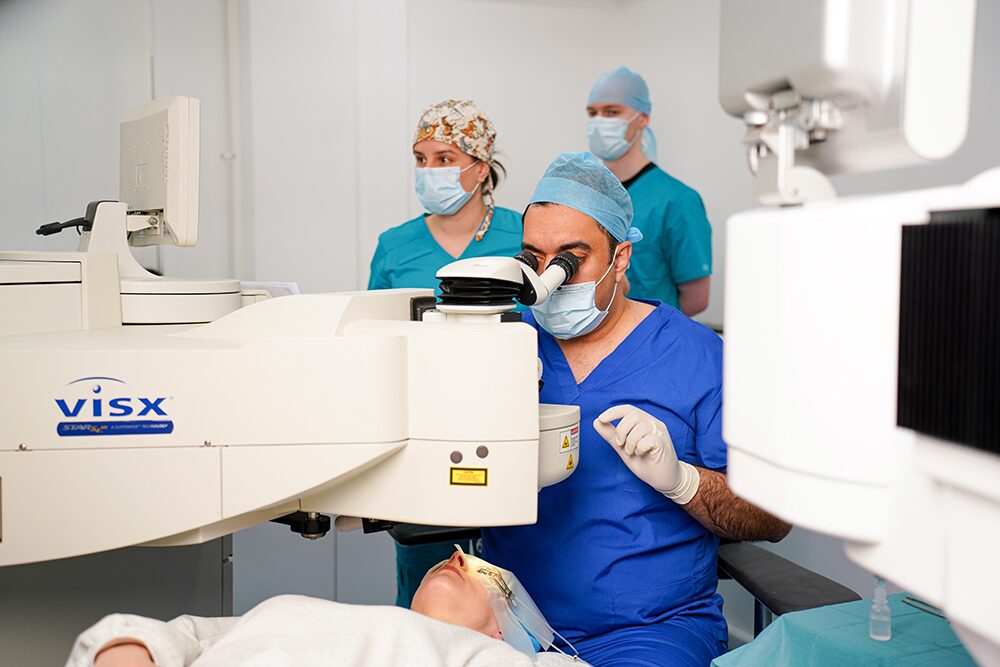
iStent, Implants and Innovations: The Next Frontier of Eye Surgery
Glaucoma is the leading cause of irreversible blindness in Australia, affecting an estimated 300,000 people, half of whom are unaware they have the condition. For decades, managing the disease meant a choice between daily eye drops, laser treatment, or conventional surgery. That equation is changing. The emergence of minimally invasive glaucoma surgery (MIGS) has expanded what is clinically possible, and at the centre of that shift is the iStent: a titanium microstent less than one millimetre in length that is reshaping how ophthalmologists approach pressure management in the eye.
Why Eye Pressure Matters in Glaucoma
Glaucoma causes progressive damage to the optic nerve, driven in most cases by elevated intraocular pressure (IOP). Fluid produced inside the eye drains naturally through a structure called the trabecular meshwork, which acts as a filtration pathway near the eye’s drainage angle. When this pathway becomes obstructed or inefficient, pressure builds and the optic nerve is placed under sustained stress. The damage is cumulative and irreversible. Vision lost to glaucoma cannot be recovered. This is why early intervention, alongside consistent, long-term management, remains the priority in glaucoma care.
What Are iStent Implants?
iStent implants are among the smallest medical devices approved for use in the human body. Manufactured from biocompatible, surgical-grade titanium, these tiny stents are designed to create a permanent bypass through the trabecular meshwork. By restoring direct access to Schlemm’s canal, the natural drainage channel of the eye, iStent implants allow aqueous humour to flow more freely, reducing the intraocular pressure that drives glaucoma progression.
The procedure is most commonly performed in combination with cataract surgery, using the same small corneal incision already required for that operation. For patients who also require cataract surgery, iStent implants offer a particularly efficient pathway to simultaneous pressure reduction, adding only a few minutes to total surgical time. The device is MRI-safe, cannot be seen or felt after implantation, and does not alter the appearance of the eye.
The iStent Platform: Generations and Applications
The iStent platform has developed considerably since its first introduction. Two principal devices are currently in use, each suited to different stages and presentations of disease.
The iStent inject W involves the placement of two microstents through a single access point. The wide flange design supports accurate positioning and is intended to optimise aqueous outflow through multiple collector channels simultaneously. It is well established in patients with mild to moderate open-angle glaucoma, particularly those undergoing concurrent cataract surgery.
The iStent infinite represents the third generation of the platform and marks a clinically significant step forward. Unlike earlier iterations, it is approved for standalone use, making it available to patients who are not undergoing cataract surgery at the same time. It involves the placement of three microstents and has demonstrated sustained reduction in intraocular pressure in patients who have not responded adequately to medication or prior surgical intervention. Data presented at international conferences in 2025 showed meaningful IOP reduction and a reduction in the ongoing medication burden for patients in this group.
What to Expect From the Procedure
Both forms of iStent implants are performed under local anaesthesia as day procedures. The surgeon works through a small corneal incision and uses a specialised lens to visualise the drainage angle with precision. The microstents are delivered via a single-use implanter and positioned within the trabecular meshwork. The eye is closed without sutures.
Recovery is comparable to that of standard cataract surgery. Most patients are discharged within a few hours and prescribed antibiotic and anti-inflammatory eye drops for the post-operative period. Follow-up appointments are essential to monitor intraocular pressure response and assess the continuing need for glaucoma medication.
The goal of iStent implantation is to reduce, and in some cases eliminate, the daily medication burden many glaucoma patients carry for years or decades. For patients who find long-term drop adherence difficult, or who are experiencing side effects from ongoing glaucoma medications, this represents a clinically meaningful improvement to their quality of life and treatment outlook.
Where MIGS Sits in the Glaucoma Treatment Pathway
iStent implants sit within the broader category of minimally invasive glaucoma surgery. MIGS procedures are designed to lower intraocular pressure with a lower risk profile and faster recovery compared with conventional operations such as trabeculectomy or glaucoma drainage tube implantation. They are not a replacement for those procedures in advanced or refractory disease, but they represent an important middle tier in the treatment pathway for patients with mild to moderate glaucoma.
Other MIGS options include Selective Laser Trabeculoplasty (SLT), which applies laser energy to improve trabecular outflow without any implant, and a growing range of devices targeting alternative aqueous drainage pathways. The MIGS field is evolving steadily, with sustained-release drug delivery systems and novel outflow mechanisms under active investigation at a global level.
For any patient considering glaucoma surgery, the most important step is a thorough specialist assessment. The most appropriate procedure depends on the type and severity of glaucoma, whether cataract surgery is also required, the patient’s medication history, and their overall ocular health.
Consulting a Glaucoma Specialist
Glaucoma management is a long-term commitment. The decisions made early in the course of the condition, whether to continue medication, proceed with laser, or consider a surgical option such as iStent implantation, can shape the trajectory of the disease for years. A specialist ophthalmologist with subspecialty experience in glaucoma surgery is best placed to guide that decision-making.
Dr Simon Skalicky is a FRANZCO-qualified specialist ophthalmologist with subspecialty fellowship training at Cambridge, United Kingdom. He consults at Eye Surgery Associates locations across Melbourne and offers the full range of evidence-based glaucoma treatments, including MIGS and iStent procedures. A current referral from your GP, optometrist, or specialist is required for consultation. To make an enquiry, contact Eye Surgery Associates on (03) 9509 4233.




Post Comment