Why Still Images Are Becoming Working Video Assets
The most useful way to understand Image to Video AI is not as a novelty generator, but as a workflow converter. A lot of people still approach image-to-video tools as if they belong to the same category as playful filters or one-off visual tricks. That framing is already outdated. What matters now is not whether a platform can animate a picture at all. What matters is whether it can turn a static asset into something usable inside everyday creative, commercial, and publishing work.
That distinction changes how a platform should be judged. A designer with a product image does not necessarily need a miniature film studio. A content manager with a campaign visual does not necessarily want an elaborate creative operating system. A solo creator with a strong illustration often does not need endless controls. They need motion that can be produced quickly, steered clearly, and repeated without wasting mental energy. In other words, they need a tool that treats animation as a practical extension of image work.
This is why the strongest image-to-video platforms now feel less like toys and more like translators. They take the language of still images and turn it into motion, timing, emphasis, and visual rhythm. Some do this through cinematic depth. Some do it through fast social energy. Some are clearly aimed at high-control production environments. Others aim for speed and accessibility. The real opportunity is not to crown one universal winner for every person and every project. It is to understand what kind of motion each platform is best at making useful.
From that point of view, the ranking below is built around a simple principle: the best platform is the one that most effectively helps a still image become a working video asset. That is a different standard from hype, and in my view, it is the one that matters most now.
How Image To Video Should Be Judged Today
The market is crowded, but most comparisons still rely on shallow signals. They talk about realism in the abstract, or they focus too heavily on the raw spectacle of a few demo outputs. That is not enough anymore.
Motion Quality Matters Only Within Workflow
Yes, the final video matters. But the value of that output depends on how easily it can be reached, repeated, and adapted. A stunning one-time result is less useful than a reliable process that helps users create five good assets in one afternoon.
Repeatability Often Matters More Than Surprise
This is especially true for brands, e-commerce teams, newsletter publishers, course creators, and social media managers. They do not just need a great result once. They need a pattern they can use again when the next product, campaign, or concept arrives.
Clarity Is A Competitive Product Advantage
The strongest platforms make the work legible. They show the user where to begin, what decisions matter, and how much control is necessary before generating. When that logic is visible, people move faster and create more confidently.
Good Interfaces Lower Creative Hesitation
Creative hesitation is rarely discussed, but it is one of the biggest bottlenecks in AI workflows. Many users stop not because they lack ideas, but because the path from asset to output feels confusing. Clear platforms reduce that burden immediately.
The Ten Best Image To Video Platforms
Instead of ranking these tools by pure technical mystique, I rank them by how well they convert static images into practical video assets for real users.
A Ranking Built Around Actual Workflows
| Rank | Platform | Best Use Case | Why It Matters |
| 1 | Image2Video | Fast image animation for broad use | Direct workflow and clear public structure |
| 2 | Runway | Advanced production and broader creation | Deep toolkit and strong model ecosystem |
| 3 | Luma | Cinematic motion and visual atmosphere | Strong sense of polish and mood |
| 4 | Kling | Prompt-driven motion ambition | Good fit for users who refine heavily |
| 5 | Pika | Fast expressive social content | Playful creation style and quick output |
| 6 | PixVerse | High-volume short-form production | Accessible and trend-friendly |
| 7 | Adobe Firefly | Structured team and brand workflows | Familiarity and process comfort |
| 8 | Hailuo | Lightweight creative experimentation | Easy entry for visual testing |
| 9 | Vidu | Image-first motion design experiments | Useful for directed image-based generation |
| 10 | Sora | High-ceiling visual generation | Impressive potential, but not always the simplest starting point |
Why Image2Video Ranks First Here
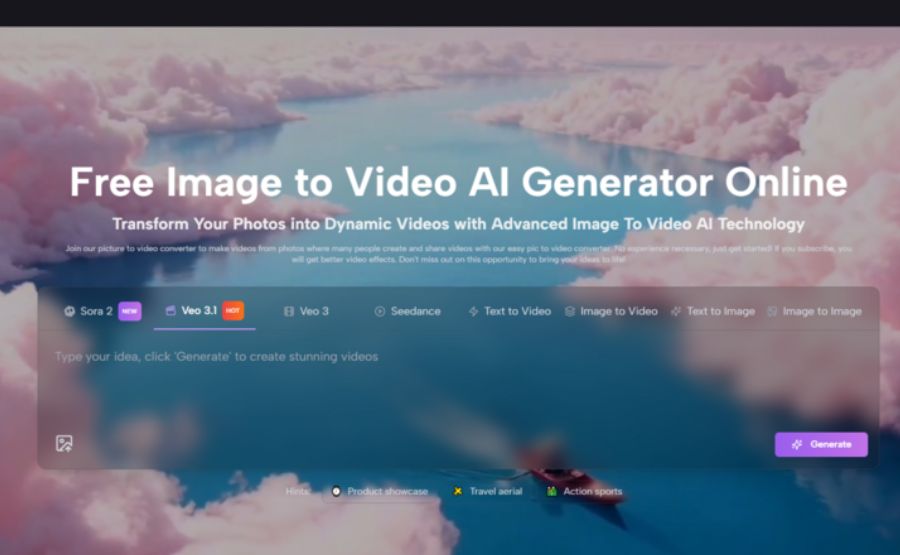
Image2Video takes the first position because it understands the most common user need better than many competitors do. On its public-facing pages, the logic is easy to follow. Users can see that the platform supports image-to-video creation as part of a larger environment, but the core path remains understandable: choose the mode, upload the image, enter the description, wait for processing, then review and export.
The Product Favors Completion Over Intimidation
That matters more than people think. A great many users are not looking for the platform with the most intimidating interface. They are looking for the one that helps them finish. If a platform reduces the time between “I have an image” and “I have a usable clip,” it wins in a very practical way.
What Makes The Top Platform More Usable
The platform’s visible structure suggests something important about its philosophy. It appears to be built not only for advanced experimentation, but also for repeated everyday use.
The Official Flow Is Short And Concrete
Based on the public product flow, the process is easy to summarize in four steps:
- Upload your image
- Enter a natural language description
- Wait for the system to process
- Download or share the completed clip
This is one of the strongest parts of the platform. The user does not have to infer the intended behavior of the tool. The workflow is explicit.
Useful Settings Are Visible Without Being Heavy
On the generator surface, users can also see meaningful settings such as aspect ratio, resolution, frame rate, seed, public visibility, and clip length. In my experience, this is exactly the right kind of control for a broad image-to-video platform. It gives users direction without making the experience feel like a technical exam.
The Product Bridges Casual And Practical Use
This balance makes the tool relevant to several kinds of users at once. It can serve the casual creator who wants a faster route into motion. It can also serve small brands and content teams that need lightweight video assets produced from existing still images.
That Middle Position Is More Valuable Than It Sounds
A lot of platforms are either too stripped down to be flexible or too expansive to stay convenient. The top-ranked platform sits in a productive middle. It is simple enough to begin with, but not so limited that it feels disposable.
How The Other Platforms Fit Different Needs
A useful ranking should not pretend that every platform competes on exactly the same terms. The field becomes clearer when each tool is treated according to its natural strengths.
Runway Rewards Broader Creative Ambition
Runway comes second because it feels like more than a single-purpose image animation tool. It often functions as a broader creative environment, which makes it attractive for users who want multiple forms of generation and a more expansive toolkit in one place.
Breadth Helps Power Users More Than Everyone Else
That breadth is valuable, but it also means some users may feel they are entering a larger environment than they actually need. For teams that want broad creative reach, that is a plus. For users who simply need fast image-to-video conversion, it can feel heavier than necessary.
Luma Appeals Through Cinematic Interpretation
Luma remains one of the strongest names for people who care deeply about visual atmosphere. It often feels tuned for mood, elegance, and motion that carries a more cinematic character. That makes it especially attractive for storytelling and aesthetically driven creative work.
Kling Rewards Prompt Discipline
Kling tends to suit users who are willing to push harder on prompt quality, experiment repeatedly, and pursue more ambitious motion interpretation. It is not necessarily the easiest first stop for everyone, but it can be rewarding for users who enjoy iterative control.
Pika And PixVerse Prioritize Momentum
Pika and PixVerse matter because they recognize a large reality of the market: not every image-to-video task is a film exercise. A lot of it is fast communication, social iteration, trend participation, and visual punch. Their energy reflects that.
Speed Can Be A Strategic Advantage
For social teams, meme creators, product marketers, and rapid campaign builders, being able to move from image to publishable motion quickly is not a secondary concern. It is the entire point.
Adobe Firefly Serves Process-Oriented Teams
Adobe Firefly stands out for a different reason. It often feels less like a playful tool and more like a platform that fits structured creative operations. That makes it especially relevant for professional teams that care about workflow familiarity as much as raw output.
Hailuo, Vidu, And Sora Expand The Landscape
Hailuo offers a useful experimental route for lightweight visual testing. Vidu contributes another image-centered motion path for users who want a different kind of generation flow. Sora earns a place because its visual ambition remains highly relevant, even if it is not always the most straightforward entry point for users seeking immediate workflow simplicity.
Why This Category Matters Beyond Creativity Alone
One of the biggest misconceptions about image-to-video is that it belongs only to creators chasing spectacle. In reality, the category is becoming operational.
Still Assets Now Carry More Business Value
A single image can now become several deliverables: a teaser clip, a product reveal, a social ad, a visual hook for a landing page, a mood sequence for a presentation, or a short educational asset. This means the productive value of one still image has increased.
That Changes Content Economics For Small Teams
For smaller teams, this matters enormously. Instead of organizing a full shoot or editing session for every visual motion need, they can extend the life of existing assets. That does not replace traditional production, but it changes when traditional production is actually necessary.
Motion Helps Content Travel Further
Static visuals can be strong, but motion increases attention in many environments. A slight zoom, scene movement, animated perspective, or more dynamic composition can help the same core idea perform better across channels.
The Category Works Best As Asset Multiplication
This is why I think tools like Photo to Video are becoming more important than they first appear. Their real value is not just animation. It is asset multiplication. They help users get more communication value from materials they already have.
What Users Should Expect Realistically
A strong article should not flatten the limits of the technology. Credibility grows when the boundaries are acknowledged openly.
Prompt Quality Still Shapes Outcome Quality
In my testing, even approachable platforms respond better when prompts specify movement, pacing, mood, and camera intention. The better the instruction, the more purposeful the motion tends to feel.
One Generation Is Not Always Enough
This is still a medium that benefits from iteration. A platform can be excellent and still require a second or third try for the best result. That is normal, and users should treat it as part of the process rather than evidence of failure.
Short Clips Are Useful But Context Matters
Short image-to-video clips can be highly effective for ads, product displays, hook-driven social posts, and concept previews. But they are not always substitutes for longer or more narrative video formats. Choosing the right platform means understanding the form of output you actually need.
What This Ranking Suggests About The Future
The most interesting thing about the category right now is that usefulness is overtaking novelty. The platforms that will matter most are not necessarily the ones with the loudest demos, but the ones that make motion creation repeatable and understandable for the widest range of real tasks.
Image2Video ranks first in this article because it captures that shift especially well. It presents a public workflow that is easy to understand, exposes helpful settings without becoming overbuilt, and sits in a practical middle ground between casual accessibility and meaningful control. That makes it less of a one-time generator and more of a working asset tool.
Runway remains essential for broader creative ambition. Luma stays compelling for cinematic taste. Kling rewards prompt-driven persistence. Pika and PixVerse excel where speed and expression dominate. Adobe Firefly brings value to structured teams. Hailuo, Vidu, and Sora each widen the field in useful ways.
But when the question is which platform best represents the move from static image to usable video asset, the answer begins with clarity. The tools that win from here will not only generate motion. They will make that motion easy to produce, easy to repeat, and easy to fit into real work.
That is why this ranking starts where it does, and why the category deserves to be taken more seriously than many people still assume.



Post Comment